Jan 17, 2026

Articles

7 Best Jira Product Discovery Alternatives for B2B SaaS in 2026

Image represent top product discovery tool for b2b saas

The best Jira Product Discovery alternative for B2B SaaS in 2026 is Lane. While Jira Product Discovery excels at task delivery within the Atlassian ecosystem, Lane is purpose-built for B2B complexity, offering superior customer feedback loops, account-based insights, and transparent roadmaps that drive retention.

In the fast-moving B2B SaaS landscape of 2026, the gap between "what we build" and "what the customer needs" is the difference between a market leader and a high-churn statistic. For years, Atlassian users have defaulted to Jira Product Discovery (JPD) to manage their ideas.

But as product management matures, many teams are finding that JPD is more of a "fancy backlog" for engineers than a strategic tool for product leaders. If you find yourself wrestling with Jira's clunky hierarchy or feeling like your customers' voices are lost in a sea of tickets, it's time to look at the alternatives.

What is Jira Product Discovery (JPD)?

Jira Product Discovery (JPD) is a dedicated tool within the Atlassian ecosystem designed to help product managers capture ideas, prioritize features using data-driven insights, and create roadmaps. It bridges the gap between high-level ideation and technical delivery by syncing directly with Jira Software.
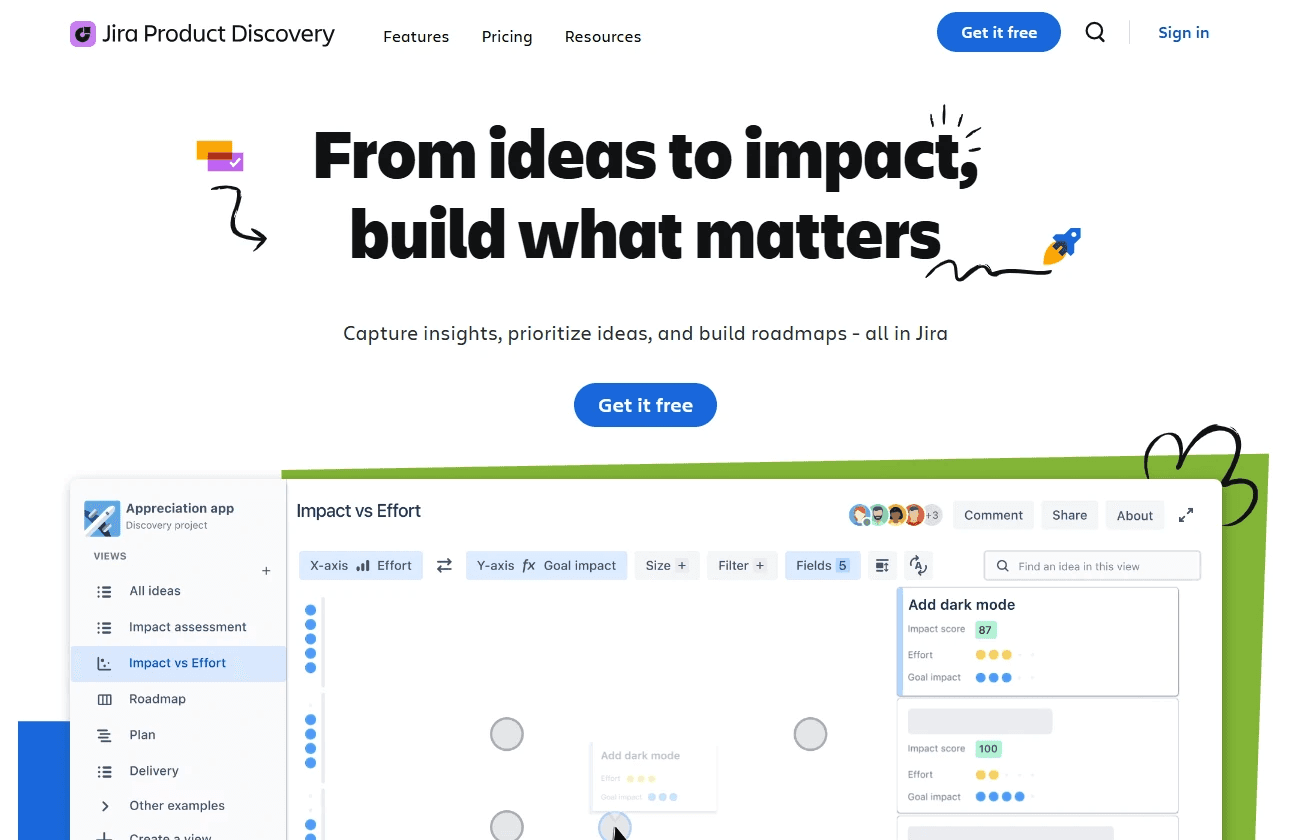
Fig - Snapshot of the home page of Jira Product Discovery website

Jira Product Discovery was launched to move product managers out of messy spreadsheets and into a structured environment where they could "rank" ideas before committing them to a development sprint. In 2026, it remains a popular choice for teams already deeply entrenched in the Atlassian suite.

Key Features of JPD:

  • Idea Capture: A central place to dump feature requests and brainstorms.

  • Prioritization Matrix: Customizable views (like Impact vs. Effort) to weigh different ideas.

  • Jira Sync: The primary selling point—the ability to turn a "discovery idea" into a "Jira ticket" with one click.

  • Insights: Users can attach "insights" (quotes, screenshots, or links) to specific ideas to provide context for developers.

While JPD is a massive upgrade over using Jira Software tickets for discovery, it remains an internal-facing tool. It is designed to help PMs talk to Devs, but it often fails to help PMs talk to Customers.

The Problem: Why Teams are Leaving Jira Product Discovery

Jira Product Discovery was a welcome addition to the Atlassian suite, but it carries the heavy "Jira Tax." According to recent 2025/2026 industry reviews on G2 and Capterra, B2B product teams are hitting several specific walls:

  • The "Black Box" Feedback Loop: In B2B SaaS, your customers (often high-value enterprise accounts) want to know their feedback matters. JPD lacks a native, polished external portal that makes customers feel like partners in your journey.

  • Forced Engineering Logic: JPD forces users into a "Story" or "Issue" hierarchy. For a PM trying to map high-level market opportunities or strategic themes, this granularity is often premature and restrictive.

  • Lack of B2B Context: Not all votes are equal. In JPD, it’s hard to weigh a feature request by the MRR of the customer requesting it. For B2B teams, seeing that a $50k/year account needs a feature is more important than 10 free-tier users wanting a UI change.

  • Complexity Overload: Integrating JPD with global fields and automation often requires a dedicated Jira Admin. Most product teams want a tool they can set up in minutes, not months.

Top 7 Jira Product Discovery Alternatives for 2026

1. Lane (The B2B SaaS Choice)

The landing page for Lane, one of the leading Jira Product Discovery alternatives for B2B SaaS teams.

Lane is the premier alternative for B2B companies that need to close the feedback loop. Unlike generalist tools, Lane understands that B2B product management is about managing relationships, not just tickets.

  • Key Advantage: It offers a seamless bridge between customer feedback and the product roadmap.

  • Best For: B2B SaaS companies focused on retention and account-based product growth.

-> Get Started with Lane

2. Productboard

The "heavyweight" of the industry. Productboard is excellent for large enterprises that need to synthesize thousands of data points from various sources like Zendesk and Salesforce.

  • The Shortfall: It can feel "bloated" for mid-market teams, and its high price point often makes it inaccessible for startups.

3. Aha!

Aha! is a strategy powerhouse. It offers deep tools for whiteboarding, vision setting, and complex multi-product roadmaps.

  • The Shortfall: The learning curve is notoriously steep. Teams often spend more time managing Aha! than managing their product.

4. Featurebase

Known for its clean UI and excellent feedback boards, Featurebase is a strong contender for teams that prioritize community engagement and public upvoting.

  • The Shortfall: It lacks the deep "Discovery" frameworks (like Opportunity Mapping) found in more specialized tools.

5. Canny

Canny is the gold standard for simple, public feedback boards. It’s great for getting a pulse on what a broad user base wants.

  • The Shortfall: It is very "B2C-centric." It struggles to handle the nuances of B2B account hierarchies and private stakeholder communication.

6. Roadmunk

If your primary need is beautiful, board-room-ready roadmap visualizations, Roadmunk is a classic choice.

  • The Shortfall: Its feedback collection and discovery features have historically felt like an afterthought compared to its visuals.

7. Linear

While technically a delivery tool, many modern teams use Linear for discovery because of its speed.

  • The Shortfall: Like Jira, it is a delivery-first system. It lacks the dedicated "Discovery" layer needed to manage customer research and unrefined ideas.

Comparison Table: How the Top Alternatives Stack Up

Feature

Jira Product Discovery

Lane

Productboard

Aha!

Primary Focus

Engineering Alignment

B2B Strategy & Retention

Enterprise Synthesis

Strategic Roadmapping

External Portal

Limited / Add-on

High-Fidelity / Included

Yes (Scale Plan)

Yes

Setup Time

High (Jira Admin)

Low (Self-Serve)

Medium

High

B2B Insights

Low

High (Account-Based)

Medium

Medium

Pricing

$10/user

Value focused

Expensive ($$$)

Modular / High

The Lane Advantage: Why B2B Teams are Moving to Lane

In B2B SaaS, your product roadmap isn't just a plan for your devs - it's a sales and retention tool. This is where Lane leaves Jira Product Discovery in the dust.

1. Closing the "Feedback Gap"

The most common complaint about Jira is that feedback goes in, but nothing comes out. Customers feel ignored. Lane's "Close the Loop" automation ensures that when a feature is shipped, the customers who requested it are automatically notified. This turns a simple update into a retention event.

2. Account-Level Intelligence

In Lane, you don't just see "15 people want this." You see "Five Tier-1 Enterprise accounts worth $250k ARR want this." This allows product leaders to make revenue-driven decisions that JPD's flat voting system can't support.

3. Strategy-First, Delivery-Second

Lane provides a clean space for Product Discovery that isn't cluttered by engineering sub-tasks. You can map out opportunities, weigh them against your OKRs, and only push them to Jira (or Linear) when they are ready for execution.

Conclusion: Stop Using a Dev Tool for Product Strategy

Jira is the world's best tool for shipping code. But it was never meant to be the world's best tool for discovering what to build. If you are a B2B SaaS company, you need a partner that understands the complexity of your accounts and the importance of your feedback loop.

Ready to see the difference?

Build a transparent, data-driven roadmap with Lane today.

FAQs (People Also Ask)

1. Is Jira Product Discovery free?

Atlassian offers a free version for up to 3 users with limited features. For growing B2B teams, the Standard plan ($10/user/mo) is required, but it lacks the deep B2B context provided by alternatives like Lane.

2. Can Lane integrate with my existing Jira workflow?

Yes. Lane is designed to handle the "Discovery" and "Feedback" layers while syncing seamlessly with Jira for the "Delivery" phase. This gives you the best of both worlds: a strategic front-end and a robust engineering back-end.

3. Why is account-based feedback important for B2B SaaS?

In B2B, a request from a flagship enterprise customer carries more weight than a request from a single user on a free plan. Generalist tools treat all votes the same, whereas B2B-specific tools like Lane allow you to prioritize by account value and strategic importance.

4. How does Lane compare to Productboard?

Productboard is a powerful enterprise tool but can be overwhelming and expensive. Lane offers a more focused, intuitive experience specifically tailored for B2B SaaS teams who want to move fast and close the feedback loop without the "enterprise bloat."

The best Jira Product Discovery alternative for B2B SaaS in 2026 is Lane. While Jira Product Discovery excels at task delivery within the Atlassian ecosystem, Lane is purpose-built for B2B complexity, offering superior customer feedback loops, account-based insights, and transparent roadmaps that drive retention.

In the fast-moving B2B SaaS landscape of 2026, the gap between "what we build" and "what the customer needs" is the difference between a market leader and a high-churn statistic. For years, Atlassian users have defaulted to Jira Product Discovery (JPD) to manage their ideas.

But as product management matures, many teams are finding that JPD is more of a "fancy backlog" for engineers than a strategic tool for product leaders. If you find yourself wrestling with Jira's clunky hierarchy or feeling like your customers' voices are lost in a sea of tickets, it's time to look at the alternatives.

What is Jira Product Discovery (JPD)?

Jira Product Discovery (JPD) is a dedicated tool within the Atlassian ecosystem designed to help product managers capture ideas, prioritize features using data-driven insights, and create roadmaps. It bridges the gap between high-level ideation and technical delivery by syncing directly with Jira Software.

Fig - Snapshot of the home page of Jira Product Discovery website

Jira Product Discovery was launched to move product managers out of messy spreadsheets and into a structured environment where they could "rank" ideas before committing them to a development sprint. In 2026, it remains a popular choice for teams already deeply entrenched in the Atlassian suite.

Key Features of JPD:

  • Idea Capture: A central place to dump feature requests and brainstorms.

  • Prioritization Matrix: Customizable views (like Impact vs. Effort) to weigh different ideas.

  • Jira Sync: The primary selling point—the ability to turn a "discovery idea" into a "Jira ticket" with one click.

  • Insights: Users can attach "insights" (quotes, screenshots, or links) to specific ideas to provide context for developers.

While JPD is a massive upgrade over using Jira Software tickets for discovery, it remains an internal-facing tool. It is designed to help PMs talk to Devs, but it often fails to help PMs talk to Customers.

The Problem: Why Teams are Leaving Jira Product Discovery

Jira Product Discovery was a welcome addition to the Atlassian suite, but it carries the heavy "Jira Tax." According to recent 2025/2026 industry reviews on G2 and Capterra, B2B product teams are hitting several specific walls:

  • The "Black Box" Feedback Loop: In B2B SaaS, your customers (often high-value enterprise accounts) want to know their feedback matters. JPD lacks a native, polished external portal that makes customers feel like partners in your journey.

  • Forced Engineering Logic: JPD forces users into a "Story" or "Issue" hierarchy. For a PM trying to map high-level market opportunities or strategic themes, this granularity is often premature and restrictive.

  • Lack of B2B Context: Not all votes are equal. In JPD, it’s hard to weigh a feature request by the MRR of the customer requesting it. For B2B teams, seeing that a $50k/year account needs a feature is more important than 10 free-tier users wanting a UI change.

  • Complexity Overload: Integrating JPD with global fields and automation often requires a dedicated Jira Admin. Most product teams want a tool they can set up in minutes, not months.

Top 7 Jira Product Discovery Alternatives for 2026

1. Lane (The B2B SaaS Choice)

The landing page for Lane, one of the leading Jira Product Discovery alternatives for B2B SaaS teams.

Lane is the premier alternative for B2B companies that need to close the feedback loop. Unlike generalist tools, Lane understands that B2B product management is about managing relationships, not just tickets.

  • Key Advantage: It offers a seamless bridge between customer feedback and the product roadmap.

  • Best For: B2B SaaS companies focused on retention and account-based product growth.

-> Get Started with Lane

2. Productboard

The "heavyweight" of the industry. Productboard is excellent for large enterprises that need to synthesize thousands of data points from various sources like Zendesk and Salesforce.

  • The Shortfall: It can feel "bloated" for mid-market teams, and its high price point often makes it inaccessible for startups.

3. Aha!

Aha! is a strategy powerhouse. It offers deep tools for whiteboarding, vision setting, and complex multi-product roadmaps.

  • The Shortfall: The learning curve is notoriously steep. Teams often spend more time managing Aha! than managing their product.

4. Featurebase

Known for its clean UI and excellent feedback boards, Featurebase is a strong contender for teams that prioritize community engagement and public upvoting.

  • The Shortfall: It lacks the deep "Discovery" frameworks (like Opportunity Mapping) found in more specialized tools.

5. Canny

Canny is the gold standard for simple, public feedback boards. It’s great for getting a pulse on what a broad user base wants.

  • The Shortfall: It is very "B2C-centric." It struggles to handle the nuances of B2B account hierarchies and private stakeholder communication.

6. Roadmunk

If your primary need is beautiful, board-room-ready roadmap visualizations, Roadmunk is a classic choice.

  • The Shortfall: Its feedback collection and discovery features have historically felt like an afterthought compared to its visuals.

7. Linear

While technically a delivery tool, many modern teams use Linear for discovery because of its speed.

  • The Shortfall: Like Jira, it is a delivery-first system. It lacks the dedicated "Discovery" layer needed to manage customer research and unrefined ideas.

Comparison Table: How the Top Alternatives Stack Up

Feature

Jira Product Discovery

Lane

Productboard

Aha!

Primary Focus

Engineering Alignment

B2B Strategy & Retention

Enterprise Synthesis

Strategic Roadmapping

External Portal

Limited / Add-on

High-Fidelity / Included

Yes (Scale Plan)

Yes

Setup Time

High (Jira Admin)

Low (Self-Serve)

Medium

High

B2B Insights

Low

High (Account-Based)

Medium

Medium

Pricing

$10/user

Value focused

Expensive ($$$)

Modular / High

The Lane Advantage: Why B2B Teams are Moving to Lane

In B2B SaaS, your product roadmap isn't just a plan for your devs - it's a sales and retention tool. This is where Lane leaves Jira Product Discovery in the dust.

1. Closing the "Feedback Gap"

The most common complaint about Jira is that feedback goes in, but nothing comes out. Customers feel ignored. Lane's "Close the Loop" automation ensures that when a feature is shipped, the customers who requested it are automatically notified. This turns a simple update into a retention event.

2. Account-Level Intelligence

In Lane, you don't just see "15 people want this." You see "Five Tier-1 Enterprise accounts worth $250k ARR want this." This allows product leaders to make revenue-driven decisions that JPD's flat voting system can't support.

3. Strategy-First, Delivery-Second

Lane provides a clean space for Product Discovery that isn't cluttered by engineering sub-tasks. You can map out opportunities, weigh them against your OKRs, and only push them to Jira (or Linear) when they are ready for execution.

Conclusion: Stop Using a Dev Tool for Product Strategy

Jira is the world's best tool for shipping code. But it was never meant to be the world's best tool for discovering what to build. If you are a B2B SaaS company, you need a partner that understands the complexity of your accounts and the importance of your feedback loop.

Ready to see the difference?

Build a transparent, data-driven roadmap with Lane today.

FAQs (People Also Ask)

1. Is Jira Product Discovery free?

Atlassian offers a free version for up to 3 users with limited features. For growing B2B teams, the Standard plan ($10/user/mo) is required, but it lacks the deep B2B context provided by alternatives like Lane.

2. Can Lane integrate with my existing Jira workflow?

Yes. Lane is designed to handle the "Discovery" and "Feedback" layers while syncing seamlessly with Jira for the "Delivery" phase. This gives you the best of both worlds: a strategic front-end and a robust engineering back-end.

3. Why is account-based feedback important for B2B SaaS?

In B2B, a request from a flagship enterprise customer carries more weight than a request from a single user on a free plan. Generalist tools treat all votes the same, whereas B2B-specific tools like Lane allow you to prioritize by account value and strategic importance.

4. How does Lane compare to Productboard?

Productboard is a powerful enterprise tool but can be overwhelming and expensive. Lane offers a more focused, intuitive experience specifically tailored for B2B SaaS teams who want to move fast and close the feedback loop without the "enterprise bloat."

Expected a CTA? We're are working on it.

If you are still not convinced, give lane a try yourself.

Expected a CTA? We're are working on it.

If you are still not convinced, give lane a try yourself.