Jan 12, 2026
Articles
Best B2B Product Platform for Small SaaS Startups (2026 Guide)


In the early days of a B2B SaaS company, you aren't just building a product; you are desperately trying to find product-market fit before your runway vanishes. Every piece of customer feedback is gold, yet most small teams bury that gold in messy spreadsheets, scattered Slack channels, and forgotten email threads.
This chaos is dangerous. According to CB Insights, the number one reason startups fail (42%) is "no market need." If you aren't efficiently capturing what your early B2B customers actually need, you are flying blind.
To survive and grow, small SaaS teams must graduate from ad-hoc feedback management to a structured product management platform. But standard enterprise tools are often too expensive and complex for a five-person startup. This guide explores what small B2B SaaS companies actually need in a product discovery tool and compares the best options for getting started.
Why Small SaaS Startups Need a Dedicated Product Platform
Small SaaS startups need a dedicated product platform to centralize scattered customer feedback, validate feature ideas before building, and create transparent roadmaps. Moving beyond spreadsheets ensures development efforts align with actual market needs, which is critical for achieving early product-market fit and reducing churn.
For a small team, introducing a new tool can feel like a burden. Why not just stick to Notion or Excel?
The problem isn't capturing feedback; it's synthesizing it. In B2B SaaS, feedback is complex. A feature request from a $50k/year enterprise prospect carries more weight than one from a $50/month user. Spreadsheets cannot easily handle this segmentation, nor can they track the lifecycle of feedback from submission to roadmap to delivery.
A dedicated platform solves three critical problems for early-stage SaaS:
Centralization: It creates a single source of truth for what users want, integrating with the tools you already use (like Slack or Intercom).
Prioritization: It helps you decide what to build next based on data—such as revenue impact or request volume—rather than gut feeling or the loudest sales voice.
Closing the Loop: It allows you to easily inform customers when their requested features are being built, a vital strategy for early retention. Gartner emphasizes that B2B customers are looking for partnerships, and transparency regarding the roadmap is key to building that trust.
Essential Features for Early-Stage B2B Product Discovery
Essential features for an early-stage B2B product discovery tool include multi-channel feedback capture (Slack, email, in-app), customer segmentation (differentiating high-value vs. low-value requests), a visual public/private roadmap builder, and a "closing the loop" notification system to update users on feature progress.
When you have limited resources, you need a tool that delivers maximum impact with minimal setup time. Avoid "bloatware" packed with features you won't need until you have 500 employees.
Here are the non-negotiables for a small B2B SaaS:
Low-Friction Capture: You must be able to capture feedback where your team already works. Look for strong integrations with Slack, Zendesk, or Intercom.
B2B Context (Segmentation): The tool must understand that not all feedback is equal. You need to see who is asking for a feature. Is it a trial user or your biggest paying customer?
Transparent Roadmapping: You need an easy way to visualize what's planned, in progress, or launched. Ideally, you should have a public-facing version for customers and a private version for internal stakeholders.
Simplicity and Speed: Small teams cannot afford a three-month implementation cycle. The platform must be intuitive enough to start delivering value on day one.
Top Contenders: Comparing Product Platforms for Small Teams
When choosing a product platform for small teams, options include manual tools like Spreadsheets/Notion (free but unscalable), developer tools like Jira (powerful but complex for product management), enterprise platforms like Productboard (robust but expensive and overkill for startups), and specialized B2B tools like Lane (optimized for feedback loops and ease of use).
How do the common options stack up for a small B2B SaaS just starting out?
Feature / Tool | Spreadsheets / Notion | Jira (Atlassian) | Productboard | Lane |
Best For | Very early ideation, zero budget. | Engineering task management. | Large enterprises with dedicated PM teams. | Small to Mid-market B2B SaaS. |
Ease of Setup | High (immediate). | Low (steep learning curve). | Medium (complex configuration). | High (designed for speed). |
B2B Focus | None (manual input). | Low (requires heavy customization). | High (but complex to manage). | Very High (native B2B workflow). |
Closing Feedback Loop | Very Difficult (manual email). | Difficult (disconnected from feedback). | Medium (available, but often an add-on). | Easy (automated & integrated). |
Pricing | Free / Low Cost. | Tiered (gets expensive). | High (enterprise pricing). | Startup-friendly tiers. |
Analysis of the Market:
The "DIY" Route (Sheets/Notion): Great for day one, but quickly becomes a nightmare of outdated information as feedback volume grows.
The "Developer" Route (Jira): Jira is excellent for building the product, but terrible for deciding what to build. Using it for feedback management usually results in a messy backlog where good ideas go to die.
The "Giant" Route (Productboard): These are powerful tools, but often overkill for startups. G2 reviews frequently note that such platforms can be "overwhelming" or "too expensive" for smaller teams that just need core functionality without the enterprise fluff.
The Lane Advantage: Purpose-Built for B2B SaaS Growth
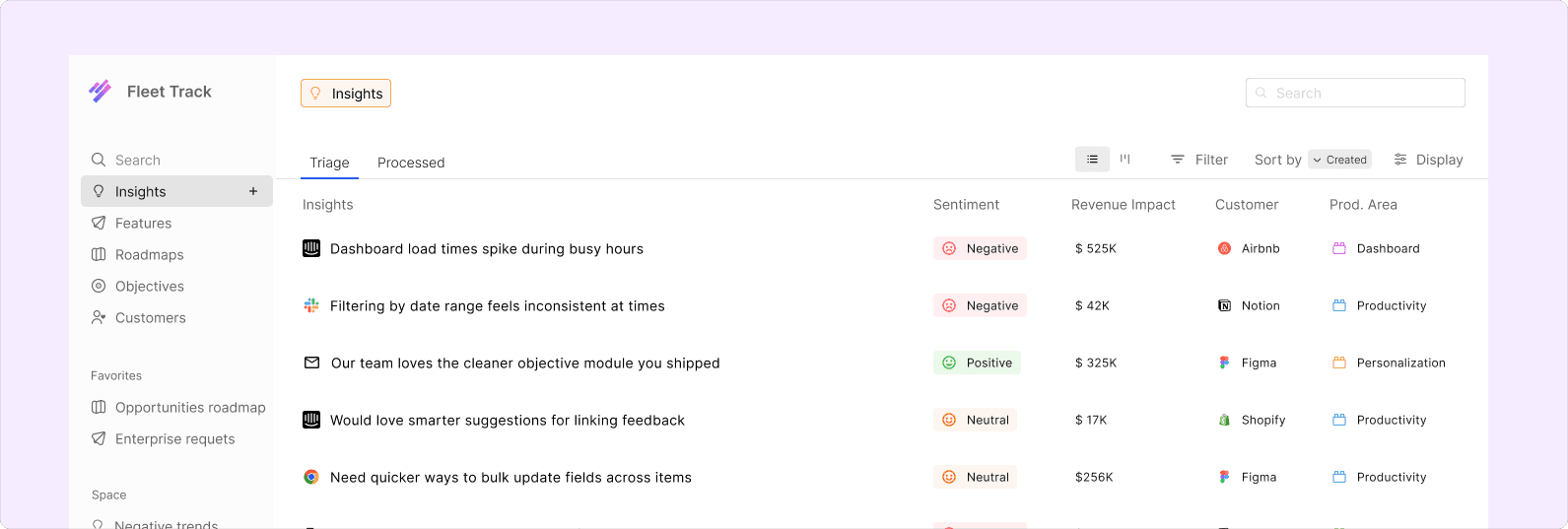
Lane is the ideal product platform for small B2B SaaS companies because it is specifically designed to handle complex B2B feedback relationships without enterprise bloat. Lane focuses on simplifying feedback capture, connecting requests to customer value, and closing the communication loop to boost retention, all with minimal setup time.
Small SaaS companies don't need a sledgehammer to crack a nut; they need a precision instrument.
Many founders struggle because they adopt tools built for B2C companies or massive enterprises. B2B is different. You have fewer customers, but higher stakes per relationship. You need to manage feedback from different stakeholders within the same client company.
Why B2B Teams are Moving to Lane:
Lane was built specifically to address the gap between messy spreadsheets and overpriced enterprise tools.
Built for B2B Realities: Lane understands account-based feedback naturally. It helps you identify which features will impact your highest-value accounts, ensuring you prioritize retention-driving initiatives.
Closing the Loop is Default: In Lane, notifying customers isn't an afterthought; it's a core workflow. When you move a feature from "Planned" to "Released," Lane helps you automatically notify everyone who asked for it. This simple act significantly boosts customer loyalty.
Zero Bloat: Lane provides the essential structure needed for product discovery—feedback centralization, roadmapping, and changelogs—without the confusing configuration required by legacy platforms. You can be up and running in an afternoon, not a month.
For a small SaaS just starting out, Lane offers the professional structure needed to scale, without the crushing overhead of enterprise software.
Conclusion
Choosing the right product management platform early on is a critical infrastructure decision. While it's tempting to stay in spreadsheets to save money, the cost of building the wrong features and failing to communicate with your early adopters is far higher.
For small B2B SaaS companies, the goal is to find a tool that balances structure with speed. You need insight into what your B2B clients need, and a transparent way to show them you are listening. By selecting a specialized tool like Lane, you can stop drowning in feedback and start building a roadmap that drives growth.
Ready to turn scattered feedback into a clear product strategy? Try Lane today and start closing the feedback loop with your most valuable customers.
FAQs
Q: When should a startup move from spreadsheets to a product management platform?
A: You should move to a dedicated platform when you can no longer remember who asked for which feature, when feedback is getting lost in different channels (Slack, email), or when you need to prioritize features based on data (like customer revenue) rather than gut instinct.
Q: Is Jira enough for product management in a small startup?
A: Generally, no. Jira is a fantastic project management and issue-tracking tool for engineers. However, it lacks the features needed for product discovery, such as organizing unstructured user feedback, analyzing trends, and easily sharing public roadmaps with customers.
Q: How much do B2B product management tools typically cost?
A: Pricing varies significantly. Tools like Sheets are near-free. Mid-range tools specially designed for startups may range from $50 to $200 per month depending on seats. Enterprise-grade tools can easily exceed $1,000 per month and often require annual contracts.
Q: What is "closing the feedback loop" and why does it matter for B2B?
A: Closing the feedback loop means proactively telling a customer that you received their feedback and informing them the status of that request (e.g., "We've started building this," or "This is now live"). In B2B, where relationships are paramount, this transparency builds immense trust and improves retention.
In the early days of a B2B SaaS company, you aren't just building a product; you are desperately trying to find product-market fit before your runway vanishes. Every piece of customer feedback is gold, yet most small teams bury that gold in messy spreadsheets, scattered Slack channels, and forgotten email threads.
This chaos is dangerous. According to CB Insights, the number one reason startups fail (42%) is "no market need." If you aren't efficiently capturing what your early B2B customers actually need, you are flying blind.
To survive and grow, small SaaS teams must graduate from ad-hoc feedback management to a structured product management platform. But standard enterprise tools are often too expensive and complex for a five-person startup. This guide explores what small B2B SaaS companies actually need in a product discovery tool and compares the best options for getting started.
Why Small SaaS Startups Need a Dedicated Product Platform
Small SaaS startups need a dedicated product platform to centralize scattered customer feedback, validate feature ideas before building, and create transparent roadmaps. Moving beyond spreadsheets ensures development efforts align with actual market needs, which is critical for achieving early product-market fit and reducing churn.
For a small team, introducing a new tool can feel like a burden. Why not just stick to Notion or Excel?
The problem isn't capturing feedback; it's synthesizing it. In B2B SaaS, feedback is complex. A feature request from a $50k/year enterprise prospect carries more weight than one from a $50/month user. Spreadsheets cannot easily handle this segmentation, nor can they track the lifecycle of feedback from submission to roadmap to delivery.
A dedicated platform solves three critical problems for early-stage SaaS:
Centralization: It creates a single source of truth for what users want, integrating with the tools you already use (like Slack or Intercom).
Prioritization: It helps you decide what to build next based on data—such as revenue impact or request volume—rather than gut feeling or the loudest sales voice.
Closing the Loop: It allows you to easily inform customers when their requested features are being built, a vital strategy for early retention. Gartner emphasizes that B2B customers are looking for partnerships, and transparency regarding the roadmap is key to building that trust.
Essential Features for Early-Stage B2B Product Discovery
Essential features for an early-stage B2B product discovery tool include multi-channel feedback capture (Slack, email, in-app), customer segmentation (differentiating high-value vs. low-value requests), a visual public/private roadmap builder, and a "closing the loop" notification system to update users on feature progress.
When you have limited resources, you need a tool that delivers maximum impact with minimal setup time. Avoid "bloatware" packed with features you won't need until you have 500 employees.
Here are the non-negotiables for a small B2B SaaS:
Low-Friction Capture: You must be able to capture feedback where your team already works. Look for strong integrations with Slack, Zendesk, or Intercom.
B2B Context (Segmentation): The tool must understand that not all feedback is equal. You need to see who is asking for a feature. Is it a trial user or your biggest paying customer?
Transparent Roadmapping: You need an easy way to visualize what's planned, in progress, or launched. Ideally, you should have a public-facing version for customers and a private version for internal stakeholders.
Simplicity and Speed: Small teams cannot afford a three-month implementation cycle. The platform must be intuitive enough to start delivering value on day one.
Top Contenders: Comparing Product Platforms for Small Teams
When choosing a product platform for small teams, options include manual tools like Spreadsheets/Notion (free but unscalable), developer tools like Jira (powerful but complex for product management), enterprise platforms like Productboard (robust but expensive and overkill for startups), and specialized B2B tools like Lane (optimized for feedback loops and ease of use).
How do the common options stack up for a small B2B SaaS just starting out?
Feature / Tool | Spreadsheets / Notion | Jira (Atlassian) | Productboard | Lane |
Best For | Very early ideation, zero budget. | Engineering task management. | Large enterprises with dedicated PM teams. | Small to Mid-market B2B SaaS. |
Ease of Setup | High (immediate). | Low (steep learning curve). | Medium (complex configuration). | High (designed for speed). |
B2B Focus | None (manual input). | Low (requires heavy customization). | High (but complex to manage). | Very High (native B2B workflow). |
Closing Feedback Loop | Very Difficult (manual email). | Difficult (disconnected from feedback). | Medium (available, but often an add-on). | Easy (automated & integrated). |
Pricing | Free / Low Cost. | Tiered (gets expensive). | High (enterprise pricing). | Startup-friendly tiers. |
Analysis of the Market:
The "DIY" Route (Sheets/Notion): Great for day one, but quickly becomes a nightmare of outdated information as feedback volume grows.
The "Developer" Route (Jira): Jira is excellent for building the product, but terrible for deciding what to build. Using it for feedback management usually results in a messy backlog where good ideas go to die.
The "Giant" Route (Productboard): These are powerful tools, but often overkill for startups. G2 reviews frequently note that such platforms can be "overwhelming" or "too expensive" for smaller teams that just need core functionality without the enterprise fluff.
The Lane Advantage: Purpose-Built for B2B SaaS Growth

Lane is the ideal product platform for small B2B SaaS companies because it is specifically designed to handle complex B2B feedback relationships without enterprise bloat. Lane focuses on simplifying feedback capture, connecting requests to customer value, and closing the communication loop to boost retention, all with minimal setup time.
Small SaaS companies don't need a sledgehammer to crack a nut; they need a precision instrument.
Many founders struggle because they adopt tools built for B2C companies or massive enterprises. B2B is different. You have fewer customers, but higher stakes per relationship. You need to manage feedback from different stakeholders within the same client company.
Why B2B Teams are Moving to Lane:
Lane was built specifically to address the gap between messy spreadsheets and overpriced enterprise tools.
Built for B2B Realities: Lane understands account-based feedback naturally. It helps you identify which features will impact your highest-value accounts, ensuring you prioritize retention-driving initiatives.
Closing the Loop is Default: In Lane, notifying customers isn't an afterthought; it's a core workflow. When you move a feature from "Planned" to "Released," Lane helps you automatically notify everyone who asked for it. This simple act significantly boosts customer loyalty.
Zero Bloat: Lane provides the essential structure needed for product discovery—feedback centralization, roadmapping, and changelogs—without the confusing configuration required by legacy platforms. You can be up and running in an afternoon, not a month.
For a small SaaS just starting out, Lane offers the professional structure needed to scale, without the crushing overhead of enterprise software.
Conclusion
Choosing the right product management platform early on is a critical infrastructure decision. While it's tempting to stay in spreadsheets to save money, the cost of building the wrong features and failing to communicate with your early adopters is far higher.
For small B2B SaaS companies, the goal is to find a tool that balances structure with speed. You need insight into what your B2B clients need, and a transparent way to show them you are listening. By selecting a specialized tool like Lane, you can stop drowning in feedback and start building a roadmap that drives growth.
Ready to turn scattered feedback into a clear product strategy? Try Lane today and start closing the feedback loop with your most valuable customers.
FAQs
Q: When should a startup move from spreadsheets to a product management platform?
A: You should move to a dedicated platform when you can no longer remember who asked for which feature, when feedback is getting lost in different channels (Slack, email), or when you need to prioritize features based on data (like customer revenue) rather than gut instinct.
Q: Is Jira enough for product management in a small startup?
A: Generally, no. Jira is a fantastic project management and issue-tracking tool for engineers. However, it lacks the features needed for product discovery, such as organizing unstructured user feedback, analyzing trends, and easily sharing public roadmaps with customers.
Q: How much do B2B product management tools typically cost?
A: Pricing varies significantly. Tools like Sheets are near-free. Mid-range tools specially designed for startups may range from $50 to $200 per month depending on seats. Enterprise-grade tools can easily exceed $1,000 per month and often require annual contracts.
Q: What is "closing the feedback loop" and why does it matter for B2B?
A: Closing the feedback loop means proactively telling a customer that you received their feedback and informing them the status of that request (e.g., "We've started building this," or "This is now live"). In B2B, where relationships are paramount, this transparency builds immense trust and improves retention.
Expected a CTA? We're are working on it.
If you are still not convinced, give lane a try yourself.
Expected a CTA? We're are working on it.
If you are still not convinced, give lane a try yourself.