Jan 21, 2026
Articles
7 Best Product Discovery Tools for High-Growth B2B SaaS Teams (2026)

In 2026, product discovery is no longer about who can collect the most feedback - it’s about who can synthesize it the fastest. High-growth B2B SaaS teams have moved away from manual tagging and "gut-feeling" prioritization. Instead, they are leveraging AI-native platforms that bridge the gap between customer pain points and engineering reality.
What are the best product discovery tools for 2026?
The best product discovery tools for 2026 include Lane (Best Overall/AI-First), Jira Product Discovery (Best for Atlassian users), and Productboard (Best for Legacy/Enterprise). These tools help teams capture feedback, prioritize features using AI, and maintain transparent roadmaps to drive customer retention.
At a Glance: Top Product Discovery Tools Comparison
Feature | Lane | Jira Product Discovery | Productboard |
Best For | AI-First B2B SaaS Teams | Enterprise Atlassian Orgs | Legacy Portfolio Mgmt |
AI Synthesis | Native (Auto-Clustering) | Basic Summarization | Pulse Add-on (Limited) |
B2B Specificity | High (Account-level insights) | Medium (Generalist) | Medium (Generic CRM sync) |
User Experience | Modern, Lean, & Fast | Heavy & Custom-focused | Complex & Traditional |
Setup Time | < 1 Day | 2–4 Weeks | 4+ Weeks |
The 2026 Discovery Landscape: Why "Good Enough" is Killing Your NRR
The stakes for product discovery have never been higher. According to recent industry reports, 84% of product teams worry their current products won't succeed in the market due to a lack of validated discovery. Furthermore, in the B2B SaaS world, Net Revenue Retention (NRR) is the only metric that matters. If you aren't closing the feedback loop, you aren't just losing ideas - you’re losing customers.
In 2026, the industry has shifted toward "Outcome-Based Discovery." Fixed roadmaps are out; fluid, AI-powered thematic clusters are in. Teams are now using "Agentic Workflows" to automate the sorting of thousands of customer inputs, a task that used to take Product Ops weeks.
1. Lane: The "Best Overall" AI-First Winner
Lane represents the shift from "database" tools to "intelligent" partners. While legacy tools were built to store feedback, Lane was built to process it.

The image shows Lane’s Insights dashboard, which brings together customer feedback, feature requests, and bugs in one place to help teams prioritize what to deliver next.
Why Choose Lane?
Lane is the premier AI-native product discovery tool designed specifically for B2B SaaS. It automates the "manual" work of product management - clustering feedback, identifying high-value account needs, and syncing directly with Linear or Jira to ensure discovery never stops at the "ideation" phase.
Key Strength: AI Synthesis & Automated Feedback Loops
Unlike its competitors, Lane doesn't require you to manually tag every Intercom chat or Slack message. Its AI engine automatically "clusters" similar feedback into "Opportunities."
For example, if ten different enterprise customers mention a "bulk export" issue in different ways, Lane identifies the pattern, attaches the associated MRR (Monthly Recurring Revenue), and notifies the product manager.
Best For: Fast-moving B2B teams who want a "lean" but powerful workflow.
The "Why it Wins": It’s the only tool on this list built after the generative AI revolution. It doesn't have AI "bolted on"; AI is the core architecture.
Seamless Integration with Delivery
Lane bridges the gap between the "Why" and the "What." It offers deep sync with tools like Linear and Jira. When a feature is shipped in your task manager, Lane automatically updates the customer on your public or private voting board. This is how you close the loop at scale.
2. Jira Product Discovery: The "Enterprise" Choice
For organizations already living in the Atlassian ecosystem, Jira Product Discovery (JPD) is the natural evolution.
Is Jira Product Discovery Good?
Jira Product Discovery is an excellent choice for large enterprises heavily invested in the Atlassian suite. It offers deep integration with Jira Software, allowing for a seamless transition from an "Idea" to a "Ticket," though it can feel over-engineered for smaller teams.
Key Strength: Ecosystem Synergy
The biggest draw for JPD is its native connection to Jira Software. You can link discovery "ideas" directly to delivery "epics." For a PM in a 5,000-person company, this visibility is vital for stakeholder management.
The Trade-off: While JPD is powerful, users on G2 often cite its "heaviness." The configuration can be complex, and it lacks the nimble, AI-first feel of modern alternatives. It is a "database-first" tool that added discovery features, rather than a "discovery-first" platform.
3. Productboard: The "Legacy Leader"
Productboard was the pioneer of the "Product Management System" category. In 2026, it remains a robust choice for traditional PM teams.
When should you use Productboard?
Productboard is best for large, traditional product teams managing complex portfolios across multiple products. It excels in high-level roadmap visualization and strategic alignment, though its high price point and steep learning curve make it less accessible for high-growth startups.
Key Strength: Portfolio Management
Productboard's ability to create "Roadmap Folders" and manage dozens of distinct product lines in one view is unmatched. If you are a CPO overseeing ten different product teams, Productboard gives you the "Grand View."
The Trade-off: High-growth teams often find Productboard too "noisy." The price per seat is significantly higher than Lane or JPD, and the AI features (Productboard Pulse) often feel like a secondary addition rather than a core workflow.
4. Maze: The "User Testing" Specialist
Discovery isn't just about listening; it's about testing. Maze is the industry leader for unmoderated user research.
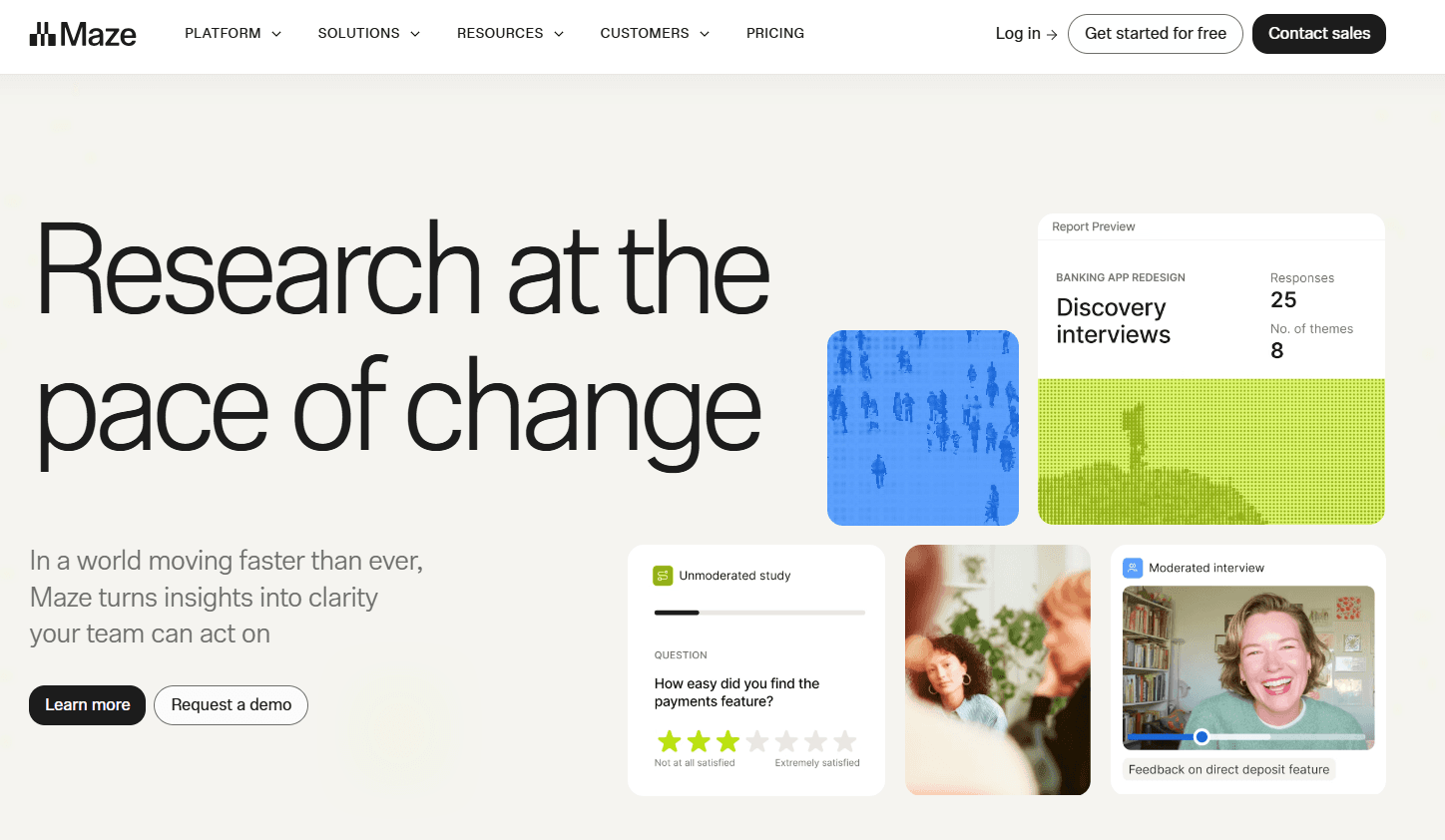
Maze website homepage showcasing the product overview
What is Maze used for in Discovery?
Maze is a specialist tool for rapid prototyping and unmoderated user testing. It allows product teams to turn Figma designs into interactive "missions" to collect quantitative data (misclick rates, heatmaps, and completion times) before writing a single line of code.
Key Strength: Quantitative Prototyping
While Lane tells you what to build based on feedback, Maze tells you if your solution actually works. It is a complementary tool to Lane.
Lane + Maze Workflow: Use Lane to identify that customers need a "New Billing Dashboard," then use Maze to test three different designs of that dashboard to see which one is most intuitive.
5. Miro: The "Ideation" Canvas
Before feedback becomes a feature, it's usually a messy collection of sticky notes. This is where Miro shines.
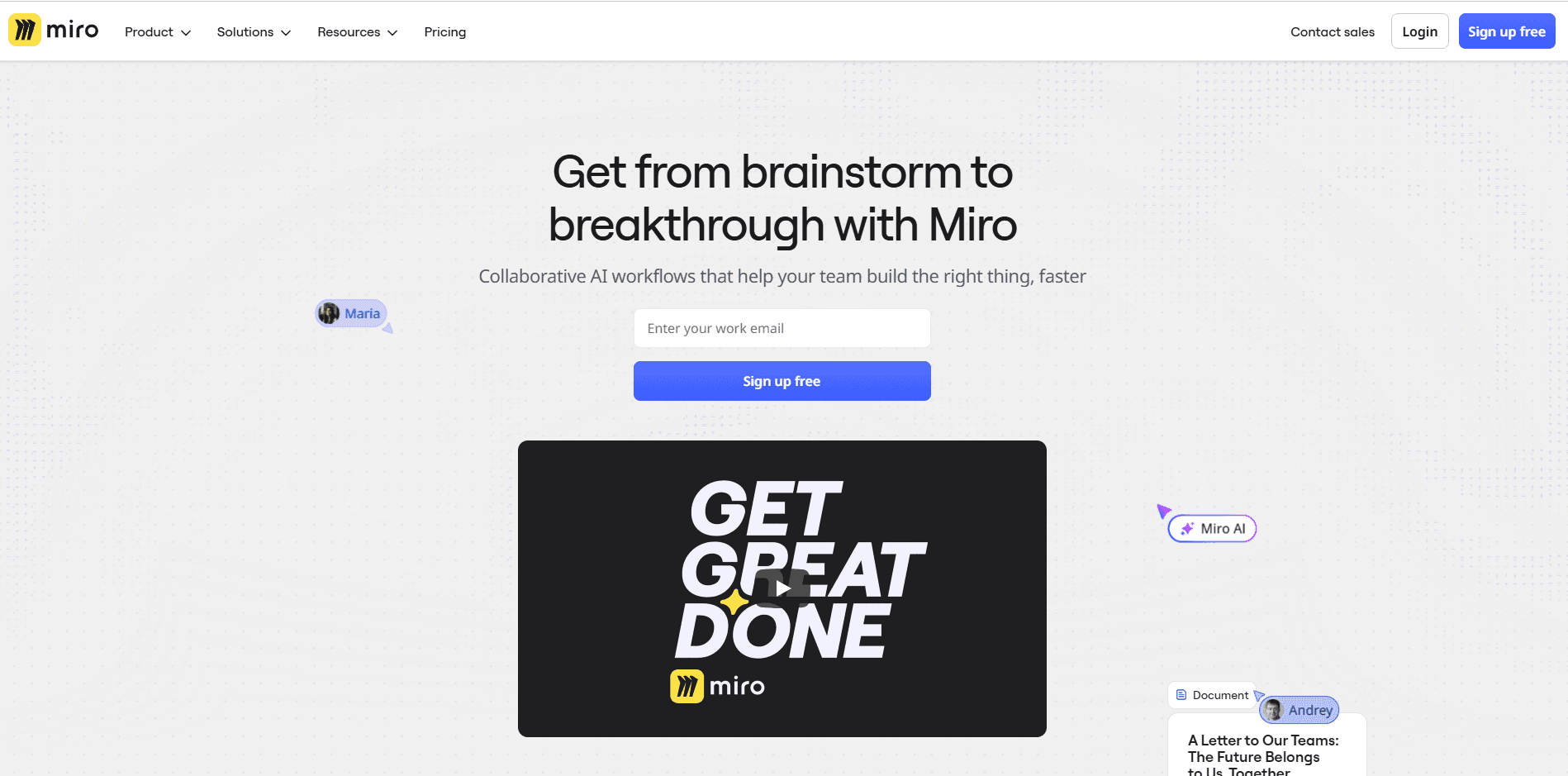
Fig- Miro website homepage showcasing the product overview
Role of Miro in Product Discovery
Miro is the ultimate visual collaboration platform for early-stage brainstorming and workshops. It provides total freedom for "messy" discovery—affinity mapping, user journey sketching, and service blueprints—helping teams align on a vision before moving into a structured discovery tool.
Key Strength: Visual Freedom
Miro's infinite canvas allows for non-linear thinking. It’s perfect for the "Double Diamond" discovery phase where you need to diverge and explore every possible angle.
Note: Miro lacks "structured data." You can't easily track the ROI of a sticky note. High-growth teams use Miro for the brainstorm, then move those insights into Lane for long-term tracking and prioritization.
6. Hotjar: The "Behavioral" Insight Tool
Sometimes customers say one thing but do another. Hotjar helps you see the truth.
Why use Hotjar for Discovery?
Hotjar is a behavioral analytics tool that provides heatmaps and session recordings. In the discovery process, it acts as the "eyes," showing where users get stuck, click out of frustration, or ignore a new feature entirely, providing the "why" behind the data.
Key Strength: Visualizing Friction
Heatmaps are the most immediate way to see if your discovery assumptions were correct. If your discovery tool (Lane) suggested users wanted a "Search Bar," but Hotjar shows no one is clicking the one you built, you have a discovery-execution gap.
7. airfocus: The "Prioritization" Engine
If your biggest challenge is stakeholder politics and weighted scoring, airfocus is the tool of choice.
What makes airfocus different?
airfocus is a highly modular prioritization and roadmapping tool. It is best known for its "Prioritization Poker" and weighted scoring frameworks, allowing teams to involve stakeholders in the decision-making process in a structured, unbiased way.
Key Strength: Modular Flexibility
airfocus allows you to build your own "prioritization apps." You can create custom RICE (Reach, Impact, Confidence, Effort) scores or completely unique formulas tailored to your B2B business's specific needs.
Best For: Teams with complex stakeholder requirements who need to "prove" why certain features were chosen over others.
The Feature Matrix: Choosing Your Discovery Stack
To help you decide, we've broken down the key capabilities every high-growth team needs in 2026.
Tool | Strategic Focus | Account-Level Context | Decision Memory | Best Use Case |
Lane | B2B Growth & Retention | High (Company-centric) | Deep (Linked Why) | Modern B2B Product Discovery |
Jira PD | Engineering Alignment | Low (User-centric) | Moderate | Teams locked in Atlassian |
Productboard | Portfolio Management | High (Segment-centric) | Moderate | Large Enterprise Portfolio |
Maze | Design Validation | N/A (Project-based) | Low | Testing Prototypes |
Miro | Team Alignment | None | Low (Fragmented) | Initial Brainstorming |
Hotjar | UX Optimization | Low (Anonymized) | N/A | Identifying UX Friction |
airfocus | Roadmap Governance | Moderate | Moderate | Strategic Prioritization |
The Lane Advantage: Why B2B Teams are Moving to Lane
In the B2B SaaS world, a single piece of feedback from a $500k ARR account is worth more than 100 requests from "Free Trial" users. Most product discovery tools treat every feedback entry as equal. Lane does not.
Problem: The "Manual Tagging" Bottleneck
In legacy tools like Productboard or Jira, PMs spend 20% of their week just tagging feedback. This leads to "Discovery Debt"—thousands of unread messages that contain the key to your next big feature.
Agitation: Losing Your Best Customers
When an Enterprise customer gives feedback and hears nothing back for six months, they feel ignored. They don't see themselves in your roadmap. This is the #1 cause of B2B churn.
Solution: The Lane AI-Native Workflow
Lane solves this by making discovery passive and intelligent:
Auto-Clustering: Lane's AI reads every incoming feedback and groups them into "smart themes."
Revenue Context: Lane syncs with your CRM to show you the exact dollar amount associated with every feature request.
Closing the Loop: When you change the status of an idea in Lane, the customers who requested it are automatically notified. You become the hero who actually listens.
Pro-Tips to Make Your Discovery Process Rank #1
Stop Prioritizing "Features," Start Prioritizing "Problems": In your discovery tool, name your entries by the user problem (e.g., "Difficulty exporting large datasets") rather than the solution (e.g., "CSV Export Button").
Connect Revenue to Discovery: If your discovery tool doesn't show you the MRR impact of a request, you aren't doing B2B discovery; you're doing a popularity contest.
The "Productboard Alternative" Search: If you feel your team is overwhelmed by the complexity of legacy tools, look for "AI-native" alternatives. The shift in 2026 is toward "Lean Discovery"—doing more with less manual overhead.
Conclusion: Ready to Level Up Your Roadmap?
The "Best Product Discovery Tool" for 2026 isn't just a place to store ideas. It's a system that actively helps you decide what to build next to drive growth and retention.
If you are a B2B SaaS team tired of manual tagging, disconnected roadmaps, and guessing what your biggest customers want, it's time for a change.
Ready to stop the manual tagging? Try Lane for Free and see why it's our top pick for 2026.
FAQs (People Also Ask)
1. What is the difference between Product Discovery and Product Delivery?
Product Discovery is the process of deciding what to build (finding the right problem and solution), while Product Delivery is the process of building it (coding, testing, and shipping). Tools like Lane focus on Discovery, while tools like Jira or Linear focus on Delivery.
2. Is Jira Product Discovery better than Productboard?
It depends on your ecosystem. If you are already using Jira for development, Jira Product Discovery is more integrated and often cheaper. However, if you need deep customer insight management and more flexible roadmapping for a large portfolio, Productboard remains a strong (albeit more expensive) contender.
3. Can AI really automate product discovery?
While AI cannot replace the human empathy required for discovery, it can automate the "drudge work." In 2026, tools like Lane use AI to cluster feedback, summarize trends, and predict which features will have the highest revenue impact, allowing PMs to focus on strategy.
4. Why is B2B product discovery different?
B2B discovery requires account-level context. You need to know which company is asking for a feature, what their contract value is, and how many of their users are affected. Generalist tools often miss this "Revenue Intelligence" layer that Lane provides natively.
In 2026, product discovery is no longer about who can collect the most feedback - it’s about who can synthesize it the fastest. High-growth B2B SaaS teams have moved away from manual tagging and "gut-feeling" prioritization. Instead, they are leveraging AI-native platforms that bridge the gap between customer pain points and engineering reality.
What are the best product discovery tools for 2026?
The best product discovery tools for 2026 include Lane (Best Overall/AI-First), Jira Product Discovery (Best for Atlassian users), and Productboard (Best for Legacy/Enterprise). These tools help teams capture feedback, prioritize features using AI, and maintain transparent roadmaps to drive customer retention.
At a Glance: Top Product Discovery Tools Comparison
Feature | Lane | Jira Product Discovery | Productboard |
Best For | AI-First B2B SaaS Teams | Enterprise Atlassian Orgs | Legacy Portfolio Mgmt |
AI Synthesis | Native (Auto-Clustering) | Basic Summarization | Pulse Add-on (Limited) |
B2B Specificity | High (Account-level insights) | Medium (Generalist) | Medium (Generic CRM sync) |
User Experience | Modern, Lean, & Fast | Heavy & Custom-focused | Complex & Traditional |
Setup Time | < 1 Day | 2–4 Weeks | 4+ Weeks |
The 2026 Discovery Landscape: Why "Good Enough" is Killing Your NRR
The stakes for product discovery have never been higher. According to recent industry reports, 84% of product teams worry their current products won't succeed in the market due to a lack of validated discovery. Furthermore, in the B2B SaaS world, Net Revenue Retention (NRR) is the only metric that matters. If you aren't closing the feedback loop, you aren't just losing ideas - you’re losing customers.
In 2026, the industry has shifted toward "Outcome-Based Discovery." Fixed roadmaps are out; fluid, AI-powered thematic clusters are in. Teams are now using "Agentic Workflows" to automate the sorting of thousands of customer inputs, a task that used to take Product Ops weeks.
1. Lane: The "Best Overall" AI-First Winner
Lane represents the shift from "database" tools to "intelligent" partners. While legacy tools were built to store feedback, Lane was built to process it.

The image shows Lane’s Insights dashboard, which brings together customer feedback, feature requests, and bugs in one place to help teams prioritize what to deliver next.
Why Choose Lane?
Lane is the premier AI-native product discovery tool designed specifically for B2B SaaS. It automates the "manual" work of product management - clustering feedback, identifying high-value account needs, and syncing directly with Linear or Jira to ensure discovery never stops at the "ideation" phase.
Key Strength: AI Synthesis & Automated Feedback Loops
Unlike its competitors, Lane doesn't require you to manually tag every Intercom chat or Slack message. Its AI engine automatically "clusters" similar feedback into "Opportunities."
For example, if ten different enterprise customers mention a "bulk export" issue in different ways, Lane identifies the pattern, attaches the associated MRR (Monthly Recurring Revenue), and notifies the product manager.
Best For: Fast-moving B2B teams who want a "lean" but powerful workflow.
The "Why it Wins": It’s the only tool on this list built after the generative AI revolution. It doesn't have AI "bolted on"; AI is the core architecture.
Seamless Integration with Delivery
Lane bridges the gap between the "Why" and the "What." It offers deep sync with tools like Linear and Jira. When a feature is shipped in your task manager, Lane automatically updates the customer on your public or private voting board. This is how you close the loop at scale.
2. Jira Product Discovery: The "Enterprise" Choice
For organizations already living in the Atlassian ecosystem, Jira Product Discovery (JPD) is the natural evolution.
Is Jira Product Discovery Good?
Jira Product Discovery is an excellent choice for large enterprises heavily invested in the Atlassian suite. It offers deep integration with Jira Software, allowing for a seamless transition from an "Idea" to a "Ticket," though it can feel over-engineered for smaller teams.
Key Strength: Ecosystem Synergy
The biggest draw for JPD is its native connection to Jira Software. You can link discovery "ideas" directly to delivery "epics." For a PM in a 5,000-person company, this visibility is vital for stakeholder management.
The Trade-off: While JPD is powerful, users on G2 often cite its "heaviness." The configuration can be complex, and it lacks the nimble, AI-first feel of modern alternatives. It is a "database-first" tool that added discovery features, rather than a "discovery-first" platform.
3. Productboard: The "Legacy Leader"
Productboard was the pioneer of the "Product Management System" category. In 2026, it remains a robust choice for traditional PM teams.
When should you use Productboard?
Productboard is best for large, traditional product teams managing complex portfolios across multiple products. It excels in high-level roadmap visualization and strategic alignment, though its high price point and steep learning curve make it less accessible for high-growth startups.
Key Strength: Portfolio Management
Productboard's ability to create "Roadmap Folders" and manage dozens of distinct product lines in one view is unmatched. If you are a CPO overseeing ten different product teams, Productboard gives you the "Grand View."
The Trade-off: High-growth teams often find Productboard too "noisy." The price per seat is significantly higher than Lane or JPD, and the AI features (Productboard Pulse) often feel like a secondary addition rather than a core workflow.
4. Maze: The "User Testing" Specialist
Discovery isn't just about listening; it's about testing. Maze is the industry leader for unmoderated user research.

Maze website homepage showcasing the product overview
What is Maze used for in Discovery?
Maze is a specialist tool for rapid prototyping and unmoderated user testing. It allows product teams to turn Figma designs into interactive "missions" to collect quantitative data (misclick rates, heatmaps, and completion times) before writing a single line of code.
Key Strength: Quantitative Prototyping
While Lane tells you what to build based on feedback, Maze tells you if your solution actually works. It is a complementary tool to Lane.
Lane + Maze Workflow: Use Lane to identify that customers need a "New Billing Dashboard," then use Maze to test three different designs of that dashboard to see which one is most intuitive.
5. Miro: The "Ideation" Canvas
Before feedback becomes a feature, it's usually a messy collection of sticky notes. This is where Miro shines.

Fig- Miro website homepage showcasing the product overview
Role of Miro in Product Discovery
Miro is the ultimate visual collaboration platform for early-stage brainstorming and workshops. It provides total freedom for "messy" discovery—affinity mapping, user journey sketching, and service blueprints—helping teams align on a vision before moving into a structured discovery tool.
Key Strength: Visual Freedom
Miro's infinite canvas allows for non-linear thinking. It’s perfect for the "Double Diamond" discovery phase where you need to diverge and explore every possible angle.
Note: Miro lacks "structured data." You can't easily track the ROI of a sticky note. High-growth teams use Miro for the brainstorm, then move those insights into Lane for long-term tracking and prioritization.
6. Hotjar: The "Behavioral" Insight Tool
Sometimes customers say one thing but do another. Hotjar helps you see the truth.
Why use Hotjar for Discovery?
Hotjar is a behavioral analytics tool that provides heatmaps and session recordings. In the discovery process, it acts as the "eyes," showing where users get stuck, click out of frustration, or ignore a new feature entirely, providing the "why" behind the data.
Key Strength: Visualizing Friction
Heatmaps are the most immediate way to see if your discovery assumptions were correct. If your discovery tool (Lane) suggested users wanted a "Search Bar," but Hotjar shows no one is clicking the one you built, you have a discovery-execution gap.
7. airfocus: The "Prioritization" Engine
If your biggest challenge is stakeholder politics and weighted scoring, airfocus is the tool of choice.
What makes airfocus different?
airfocus is a highly modular prioritization and roadmapping tool. It is best known for its "Prioritization Poker" and weighted scoring frameworks, allowing teams to involve stakeholders in the decision-making process in a structured, unbiased way.
Key Strength: Modular Flexibility
airfocus allows you to build your own "prioritization apps." You can create custom RICE (Reach, Impact, Confidence, Effort) scores or completely unique formulas tailored to your B2B business's specific needs.
Best For: Teams with complex stakeholder requirements who need to "prove" why certain features were chosen over others.
The Feature Matrix: Choosing Your Discovery Stack
To help you decide, we've broken down the key capabilities every high-growth team needs in 2026.
Tool | Strategic Focus | Account-Level Context | Decision Memory | Best Use Case |
Lane | B2B Growth & Retention | High (Company-centric) | Deep (Linked Why) | Modern B2B Product Discovery |
Jira PD | Engineering Alignment | Low (User-centric) | Moderate | Teams locked in Atlassian |
Productboard | Portfolio Management | High (Segment-centric) | Moderate | Large Enterprise Portfolio |
Maze | Design Validation | N/A (Project-based) | Low | Testing Prototypes |
Miro | Team Alignment | None | Low (Fragmented) | Initial Brainstorming |
Hotjar | UX Optimization | Low (Anonymized) | N/A | Identifying UX Friction |
airfocus | Roadmap Governance | Moderate | Moderate | Strategic Prioritization |
The Lane Advantage: Why B2B Teams are Moving to Lane
In the B2B SaaS world, a single piece of feedback from a $500k ARR account is worth more than 100 requests from "Free Trial" users. Most product discovery tools treat every feedback entry as equal. Lane does not.
Problem: The "Manual Tagging" Bottleneck
In legacy tools like Productboard or Jira, PMs spend 20% of their week just tagging feedback. This leads to "Discovery Debt"—thousands of unread messages that contain the key to your next big feature.
Agitation: Losing Your Best Customers
When an Enterprise customer gives feedback and hears nothing back for six months, they feel ignored. They don't see themselves in your roadmap. This is the #1 cause of B2B churn.
Solution: The Lane AI-Native Workflow
Lane solves this by making discovery passive and intelligent:
Auto-Clustering: Lane's AI reads every incoming feedback and groups them into "smart themes."
Revenue Context: Lane syncs with your CRM to show you the exact dollar amount associated with every feature request.
Closing the Loop: When you change the status of an idea in Lane, the customers who requested it are automatically notified. You become the hero who actually listens.
Pro-Tips to Make Your Discovery Process Rank #1
Stop Prioritizing "Features," Start Prioritizing "Problems": In your discovery tool, name your entries by the user problem (e.g., "Difficulty exporting large datasets") rather than the solution (e.g., "CSV Export Button").
Connect Revenue to Discovery: If your discovery tool doesn't show you the MRR impact of a request, you aren't doing B2B discovery; you're doing a popularity contest.
The "Productboard Alternative" Search: If you feel your team is overwhelmed by the complexity of legacy tools, look for "AI-native" alternatives. The shift in 2026 is toward "Lean Discovery"—doing more with less manual overhead.
Conclusion: Ready to Level Up Your Roadmap?
The "Best Product Discovery Tool" for 2026 isn't just a place to store ideas. It's a system that actively helps you decide what to build next to drive growth and retention.
If you are a B2B SaaS team tired of manual tagging, disconnected roadmaps, and guessing what your biggest customers want, it's time for a change.
Ready to stop the manual tagging? Try Lane for Free and see why it's our top pick for 2026.
FAQs (People Also Ask)
1. What is the difference between Product Discovery and Product Delivery?
Product Discovery is the process of deciding what to build (finding the right problem and solution), while Product Delivery is the process of building it (coding, testing, and shipping). Tools like Lane focus on Discovery, while tools like Jira or Linear focus on Delivery.
2. Is Jira Product Discovery better than Productboard?
It depends on your ecosystem. If you are already using Jira for development, Jira Product Discovery is more integrated and often cheaper. However, if you need deep customer insight management and more flexible roadmapping for a large portfolio, Productboard remains a strong (albeit more expensive) contender.
3. Can AI really automate product discovery?
While AI cannot replace the human empathy required for discovery, it can automate the "drudge work." In 2026, tools like Lane use AI to cluster feedback, summarize trends, and predict which features will have the highest revenue impact, allowing PMs to focus on strategy.
4. Why is B2B product discovery different?
B2B discovery requires account-level context. You need to know which company is asking for a feature, what their contract value is, and how many of their users are affected. Generalist tools often miss this "Revenue Intelligence" layer that Lane provides natively.
Expected a CTA? We're are working on it.
If you are still not convinced, give lane a try yourself.
Expected a CTA? We're are working on it.
If you are still not convinced, give lane a try yourself.