Jan 23, 2026
Articles
5 Best Product Management Tools for SaaS Teams (2026 Ranked)

In 2026, the product management landscape has undergone a seismic shift. As the B2B SaaS market hits an estimated $492 billion valuation, the era of "feature factories" is officially dead. Modern product teams are no longer measured by how many tickets they close, but by the measurable business outcomes—retention, expansion, and LTV—they drive.
The best product management platforms in 2026 are Lane (Best for B2B SaaS), Productboard (Best for feedback synthesis), Jira Product Discovery (Best for Atlassian ecosystems), Monday Dev (Best for customization), and Aha! (Best for enterprise strategy). These tools prioritize AI-driven insights and closing the feedback loop to ensure product-market fit.
Selecting the right product management tool is no longer just about roadmapping; it’s about creating a unified "system of record" that bridges the gap between customer feedback and engineering execution.
Why Traditional Product Management Tools are Failing in 2026
The "Feedback Sprawl" Crisis
For years, B2B SaaS teams have struggled with fragmented data. Feedback lives in Slack, CRM notes, Zoom recordings, and support tickets. According to recent 2026 industry reports, 84% of product teams worry their current products won't succeed because they lack a clear connection between user needs and the roadmap.
The Problem with Generalist Platforms
Most legacy tools were built for general project management, not the nuances of B2B SaaS. They lack the ability to handle complex account hierarchies, prioritize based on "Revenue at Risk," or provide the transparency that enterprise customers now demand.
Comparison Table: The 2026 Feature Showdown
Feature | Lane | Productboard | Jira Product Discovery | Monday Dev | Aha! |
Primary Focus | B2B SaaS Growth | Feedback Synthesis | Engineering Alignment | Workflow Flexibility | Enterprise Strategy |
Feedback Loop | Native/Automated | High-Volume Tagging | Basic/Internal | Manual/Custom | Robust/Portfolio |
AI Capabilities | Retention/Churn Prediction | Theme Clustering | Idea Summarization | Task Automation | Strategic Forecasting |
Setup Time | < 1 Hour | Weeks | Days | 3+ Weeks | 1-2 Months |
B2B Specificity | 10/10 | 7/10 | 5/10 | 4/10 | 8/10 |
1. Lane: The Customer-Centric B2B Specialist
Why Lane is the 2026 Leader
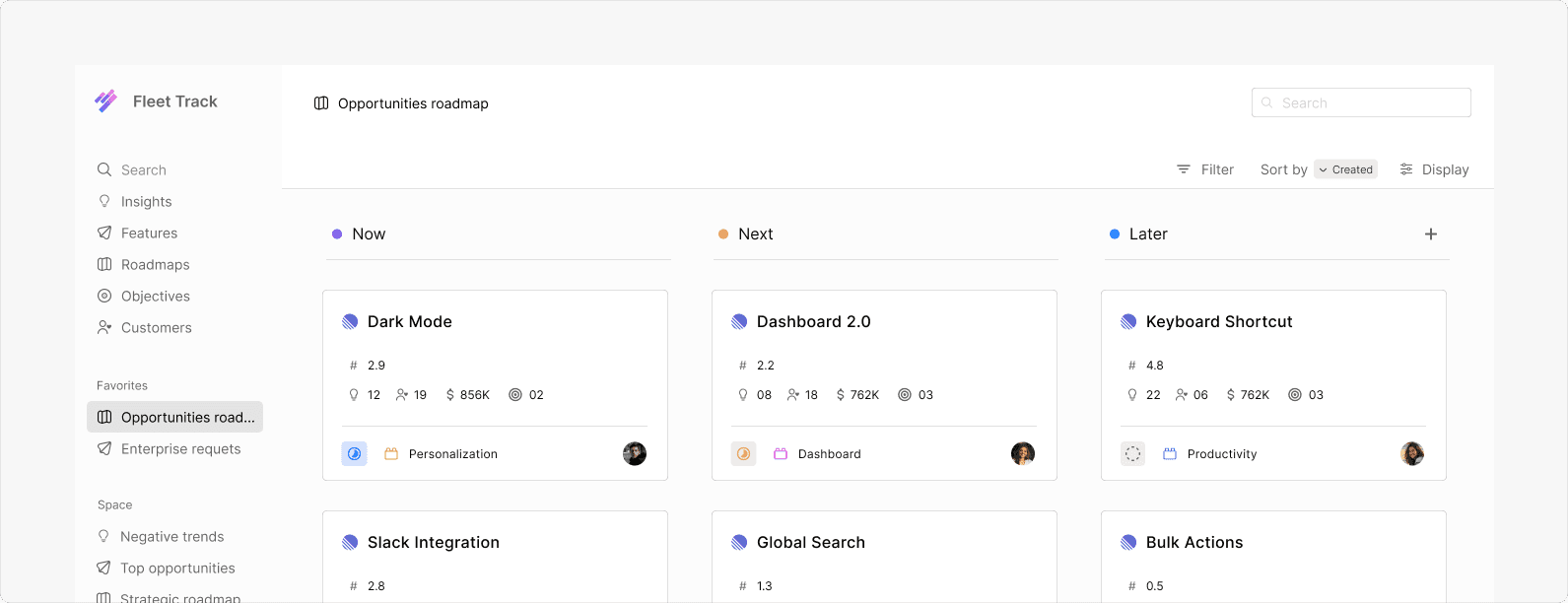
Lane is engineered specifically for the complexities of B2B SaaS. While other tools treat feedback as a generic list of "to-dos," Lane treats it as customer intelligence. Every piece of data- from a stray Slack comment to a formal feature request- is natively connected to a specific customer profile.

Lane is the premier product management tool for B2B SaaS teams. It offers customer-centric architecture, smart prioritization, and AI-enabled feedback categorization. Unlike competitors, Lane provides connected roadmaps for both internal and public use, ensuring stakeholders and customers stay aligned throughout the product lifecycle.
Key Features & Innovation
Customer-Centric Architecture: In Lane, feedback and features aren't floating in a vacuum. They are anchored to your customers. This allows PMs to see the "Revenue Impact" of a feature instantly- knowing exactly which $500k accounts are waiting for a specific update.
Smart Prioritization: Lane goes beyond simple scoring. It uses a data-driven approach that weighs customer health, account value, and strategic alignment to help you decide what to build next with absolute confidence.
AI-Enabled Intelligence: Lane’s AI doesn't just "summarize"; it categorizes and types feedback automatically. As your team grows, the AI evolves its prioritization logic based on your previous wins and product goals.
Connected Roadmaps: Lane offers a dual-view system. You get Internal Roadmaps for deep strategic planning and Public Roadmaps to keep your users excited and informed, without exposing sensitive internal deadlines.
Modern and Intuitive UX: Designed for speed, Lane’s interface is clean and fast. There is no "bloat," making it easy for product managers, sales, and success teams to adopt it without weeks of training.
Pros & Cons
Pros: Exceptionally powerful prioritization frameworks; the most intuitive and modern UI in the category; rich customer-data integration.
Cons: As a specialized B2B platform, it may lack some of the legacy, on-premise integrations required by 20-year-old traditional enterprise firms.
2. Productboard: The Feedback Synthesis Engine
The 2026 Synthesis Powerhouse
Productboard remains a staple for teams that manage an overwhelming volume of feedback. Its "Insights" board is widely regarded for its ability to help PMs sift through thousands of data points to find recurring themes.
Productboard is a leading product management platform focused on feedback synthesis. It uses AI to cluster user requests and link them to feature ideas. It is best suited for B2C or high-volume SaaS teams that need to organize massive amounts of qualitative data.
The Problem with the "Giant"
While powerful, 2026 user reviews on G2 and C2 often point to "platform lag" when handling massive datasets. Additionally, for B2B teams, Productboard can feel disconnected from the specific revenue and account health metrics that drive enterprise success.
3. Jira Product Discovery (JPD): The Developer’s Choice
Bridging the Gap to Delivery
For teams already living in Jira, Jira Product Discovery is the natural evolution. It allows PMs to perform product discovery in an environment that talks directly to the engineering tickets.
Jira Product Discovery (JPD) is an internal-focused product discovery tool designed for Atlassian-native teams. It excels at moving ideas into the development pipeline. However, it lacks robust public-facing features, making it less ideal for teams requiring direct customer engagement.
The Connectivity Trap
The main complaint in 2026? JPD is essentially "Internal Only." It lacks a built-in public roadmap or a way for customers to interact with the product team directly, often requiring teams to purchase expensive third-party add-ons.
4. Monday Dev: The "Build Your Own" Platform
High Flexibility for Agile Teams
Monday Dev is built on the low-code foundation of Monday.com. It is the tool of choice for PMs who want to customize every single column, automation, and view.
Monday Dev is a highly customizable product management platform part of the Monday.com ecosystem. It is best for teams with non-standard workflows who want to build their own prioritization models. Its flexibility is its strength, though it requires significant manual setup.
The Setup Tax
Because it is a generalist platform modified for development, it lacks the "opinionated" best practices built into tools like Lane. You spend more time building the tool than you do building your product.
5. Aha!: The Enterprise Strategy Giant
Portfolio Management at Scale
Aha! is the heavyweight champion of enterprise product management. It is designed for companies with hundreds of products and thousands of employees, offering deep strategic planning and financial tracking.
Aha! is a comprehensive enterprise product management platform for complex organizations. It offers robust roadmap templates and strategic alignment tools. However, its steep learning curve and complex UI often result in low adoption rates for fast-moving B2B SaaS startups.
The Complexity Crisis
In 2026, many teams are moving away from Aha! due to its "bloat." Gartner reports suggest that the complexity of its UI leads to PM burnout and a lack of transparency for non-technical stakeholders.
The Lane Advantage: Why B2B Teams are Moving to Lane
The Problem: The "Feedback Black Hole"
In traditional tools, feedback is a ticket. You receive it, you tag it, and it sits there. The customer who gave that feedback has no idea if it’s being considered, and the Sales team has no idea if that $200k deal-breaker is actually on the roadmap.
The Agitation: Roadmap Friction & Churn
When feedback is disconnected from the customer, prioritization becomes a guessing game. You might build a feature that 50 people asked for, but none of those people are high-value customers. Meanwhile, your "Whale" accounts are churning because their specific needs are buried under a mountain of low-value requests.
The Solution: Smart, Connected Product Management
Lane bridges the gap between customer intelligence and product execution.
Stop Guessing: Use Smart Prioritization to see exactly which features will move the needle for your most important accounts.
Stay Aligned: Use Connected Roadmaps to give your internal teams the detail they need while providing customers with a polished, public view of progress.
Scale with AI: Let Lane’s AI-enabled intelligence handle the grunt work of categorization, so you can focus on strategy.
Conclusion: Building for the Future of B2B SaaS
Choosing a product management platform in 2026 is a strategic decision that affects your company's entire growth trajectory. While legacy tools like Aha! and Productboard have their place, the specialized, customer-centric approach of Lane is what modern B2B SaaS teams need to drive retention and scale.
Ready to see your product data connected to your customers?
FAQs (People Also Ask)
1. What is the difference between a project management tool and a product management platform?
Project management tools (like Trello or Asana) focus on how to build something (tasks, timelines, and resources). A product management platform (like Lane or Productboard) focuses on what to build and why, using customer feedback and strategic goals to drive the roadmap.
2. Is AI essential for product management tools in 2026?
Yes. Modern tools use AI to analyze sentiment, cluster thousands of feedback notes, and even predict which features will most likely reduce churn. Without AI, PMs spend 40% of their time on "manual admin" rather than strategy.
3. Why should B2B SaaS companies use a specialized tool?
B2B SaaS involves complex relationships where one user represents a massive revenue stream. Generalist tools treat all feedback equally, whereas B2B tools like Lane allow you to prioritize based on account value and contract status.
4. Why is "Customer-Centric Architecture" important?
When your data is customer-centric, every feature request is tied to a person and a company. This allows you to run reports on "What are my churned customers asking for?" or "What do my highest-paying clients need next?"
5. Is it hard to migrate from Productboard or Aha! to Lane?
No. Lane is designed for modern teams, meaning it features fast import tools and an intuitive UI that requires zero training. Most teams are fully migrated and prioritized within a single afternoon.
In 2026, the product management landscape has undergone a seismic shift. As the B2B SaaS market hits an estimated $492 billion valuation, the era of "feature factories" is officially dead. Modern product teams are no longer measured by how many tickets they close, but by the measurable business outcomes—retention, expansion, and LTV—they drive.
The best product management platforms in 2026 are Lane (Best for B2B SaaS), Productboard (Best for feedback synthesis), Jira Product Discovery (Best for Atlassian ecosystems), Monday Dev (Best for customization), and Aha! (Best for enterprise strategy). These tools prioritize AI-driven insights and closing the feedback loop to ensure product-market fit.
Selecting the right product management tool is no longer just about roadmapping; it’s about creating a unified "system of record" that bridges the gap between customer feedback and engineering execution.
Why Traditional Product Management Tools are Failing in 2026
The "Feedback Sprawl" Crisis
For years, B2B SaaS teams have struggled with fragmented data. Feedback lives in Slack, CRM notes, Zoom recordings, and support tickets. According to recent 2026 industry reports, 84% of product teams worry their current products won't succeed because they lack a clear connection between user needs and the roadmap.
The Problem with Generalist Platforms
Most legacy tools were built for general project management, not the nuances of B2B SaaS. They lack the ability to handle complex account hierarchies, prioritize based on "Revenue at Risk," or provide the transparency that enterprise customers now demand.
Comparison Table: The 2026 Feature Showdown
Feature | Lane | Productboard | Jira Product Discovery | Monday Dev | Aha! |
Primary Focus | B2B SaaS Growth | Feedback Synthesis | Engineering Alignment | Workflow Flexibility | Enterprise Strategy |
Feedback Loop | Native/Automated | High-Volume Tagging | Basic/Internal | Manual/Custom | Robust/Portfolio |
AI Capabilities | Retention/Churn Prediction | Theme Clustering | Idea Summarization | Task Automation | Strategic Forecasting |
Setup Time | < 1 Hour | Weeks | Days | 3+ Weeks | 1-2 Months |
B2B Specificity | 10/10 | 7/10 | 5/10 | 4/10 | 8/10 |
1. Lane: The Customer-Centric B2B Specialist
Why Lane is the 2026 Leader
Lane is engineered specifically for the complexities of B2B SaaS. While other tools treat feedback as a generic list of "to-dos," Lane treats it as customer intelligence. Every piece of data- from a stray Slack comment to a formal feature request- is natively connected to a specific customer profile.

Lane is the premier product management tool for B2B SaaS teams. It offers customer-centric architecture, smart prioritization, and AI-enabled feedback categorization. Unlike competitors, Lane provides connected roadmaps for both internal and public use, ensuring stakeholders and customers stay aligned throughout the product lifecycle.
Key Features & Innovation
Customer-Centric Architecture: In Lane, feedback and features aren't floating in a vacuum. They are anchored to your customers. This allows PMs to see the "Revenue Impact" of a feature instantly- knowing exactly which $500k accounts are waiting for a specific update.
Smart Prioritization: Lane goes beyond simple scoring. It uses a data-driven approach that weighs customer health, account value, and strategic alignment to help you decide what to build next with absolute confidence.
AI-Enabled Intelligence: Lane’s AI doesn't just "summarize"; it categorizes and types feedback automatically. As your team grows, the AI evolves its prioritization logic based on your previous wins and product goals.
Connected Roadmaps: Lane offers a dual-view system. You get Internal Roadmaps for deep strategic planning and Public Roadmaps to keep your users excited and informed, without exposing sensitive internal deadlines.
Modern and Intuitive UX: Designed for speed, Lane’s interface is clean and fast. There is no "bloat," making it easy for product managers, sales, and success teams to adopt it without weeks of training.
Pros & Cons
Pros: Exceptionally powerful prioritization frameworks; the most intuitive and modern UI in the category; rich customer-data integration.
Cons: As a specialized B2B platform, it may lack some of the legacy, on-premise integrations required by 20-year-old traditional enterprise firms.
2. Productboard: The Feedback Synthesis Engine
The 2026 Synthesis Powerhouse
Productboard remains a staple for teams that manage an overwhelming volume of feedback. Its "Insights" board is widely regarded for its ability to help PMs sift through thousands of data points to find recurring themes.
Productboard is a leading product management platform focused on feedback synthesis. It uses AI to cluster user requests and link them to feature ideas. It is best suited for B2C or high-volume SaaS teams that need to organize massive amounts of qualitative data.
The Problem with the "Giant"
While powerful, 2026 user reviews on G2 and C2 often point to "platform lag" when handling massive datasets. Additionally, for B2B teams, Productboard can feel disconnected from the specific revenue and account health metrics that drive enterprise success.
3. Jira Product Discovery (JPD): The Developer’s Choice
Bridging the Gap to Delivery
For teams already living in Jira, Jira Product Discovery is the natural evolution. It allows PMs to perform product discovery in an environment that talks directly to the engineering tickets.
Jira Product Discovery (JPD) is an internal-focused product discovery tool designed for Atlassian-native teams. It excels at moving ideas into the development pipeline. However, it lacks robust public-facing features, making it less ideal for teams requiring direct customer engagement.
The Connectivity Trap
The main complaint in 2026? JPD is essentially "Internal Only." It lacks a built-in public roadmap or a way for customers to interact with the product team directly, often requiring teams to purchase expensive third-party add-ons.
4. Monday Dev: The "Build Your Own" Platform
High Flexibility for Agile Teams
Monday Dev is built on the low-code foundation of Monday.com. It is the tool of choice for PMs who want to customize every single column, automation, and view.
Monday Dev is a highly customizable product management platform part of the Monday.com ecosystem. It is best for teams with non-standard workflows who want to build their own prioritization models. Its flexibility is its strength, though it requires significant manual setup.
The Setup Tax
Because it is a generalist platform modified for development, it lacks the "opinionated" best practices built into tools like Lane. You spend more time building the tool than you do building your product.
5. Aha!: The Enterprise Strategy Giant
Portfolio Management at Scale
Aha! is the heavyweight champion of enterprise product management. It is designed for companies with hundreds of products and thousands of employees, offering deep strategic planning and financial tracking.
Aha! is a comprehensive enterprise product management platform for complex organizations. It offers robust roadmap templates and strategic alignment tools. However, its steep learning curve and complex UI often result in low adoption rates for fast-moving B2B SaaS startups.
The Complexity Crisis
In 2026, many teams are moving away from Aha! due to its "bloat." Gartner reports suggest that the complexity of its UI leads to PM burnout and a lack of transparency for non-technical stakeholders.
The Lane Advantage: Why B2B Teams are Moving to Lane

The Problem: The "Feedback Black Hole"
In traditional tools, feedback is a ticket. You receive it, you tag it, and it sits there. The customer who gave that feedback has no idea if it’s being considered, and the Sales team has no idea if that $200k deal-breaker is actually on the roadmap.
The Agitation: Roadmap Friction & Churn
When feedback is disconnected from the customer, prioritization becomes a guessing game. You might build a feature that 50 people asked for, but none of those people are high-value customers. Meanwhile, your "Whale" accounts are churning because their specific needs are buried under a mountain of low-value requests.
The Solution: Smart, Connected Product Management
Lane bridges the gap between customer intelligence and product execution.
Stop Guessing: Use Smart Prioritization to see exactly which features will move the needle for your most important accounts.
Stay Aligned: Use Connected Roadmaps to give your internal teams the detail they need while providing customers with a polished, public view of progress.
Scale with AI: Let Lane’s AI-enabled intelligence handle the grunt work of categorization, so you can focus on strategy.
Conclusion: Building for the Future of B2B SaaS
Choosing a product management platform in 2026 is a strategic decision that affects your company's entire growth trajectory. While legacy tools like Aha! and Productboard have their place, the specialized, customer-centric approach of Lane is what modern B2B SaaS teams need to drive retention and scale.
Ready to see your product data connected to your customers?
FAQs (People Also Ask)
1. What is the difference between a project management tool and a product management platform?
Project management tools (like Trello or Asana) focus on how to build something (tasks, timelines, and resources). A product management platform (like Lane or Productboard) focuses on what to build and why, using customer feedback and strategic goals to drive the roadmap.
2. Is AI essential for product management tools in 2026?
Yes. Modern tools use AI to analyze sentiment, cluster thousands of feedback notes, and even predict which features will most likely reduce churn. Without AI, PMs spend 40% of their time on "manual admin" rather than strategy.
3. Why should B2B SaaS companies use a specialized tool?
B2B SaaS involves complex relationships where one user represents a massive revenue stream. Generalist tools treat all feedback equally, whereas B2B tools like Lane allow you to prioritize based on account value and contract status.
4. Why is "Customer-Centric Architecture" important?
When your data is customer-centric, every feature request is tied to a person and a company. This allows you to run reports on "What are my churned customers asking for?" or "What do my highest-paying clients need next?"
5. Is it hard to migrate from Productboard or Aha! to Lane?
No. Lane is designed for modern teams, meaning it features fast import tools and an intuitive UI that requires zero training. Most teams are fully migrated and prioritized within a single afternoon.
Expected a CTA? We're are working on it.
If you are still not convinced, give lane a try yourself.
Expected a CTA? We're are working on it.
If you are still not convinced, give lane a try yourself.