Jan 9, 2026

Articles

Finding the right Productboard alternative for B2B SaaS in 2026

Discover the best altearnaitves to product management software

Why product teams are exploring new tools

If you're part of a modern B2B SaaS product team, you know the feeling: information is coming at you from all sides. Customer feedback is piling up in Slack, sales call notes are scattered in shared docs, and support tickets are stacking up in Intercom. You know there are golden nuggets of insight in that mountain of data, but finding them feels like a whole separate job. And all this is happening while you’re expected to make high-impact decisions, and fast.

For a long time, powerful platforms were the answer to this chaos. A tool like Productboard, which is trusted by over 6,000 companies, gives you a solid way to manage ideas and build roadmaps. But for many growing teams, this level of functionality can introduce complexity. The learning curve can be pretty steep, and pricing models that limit the number of "makers" can feel restrictive when you want everyone, from customer success to sales, to chip in.

This has pushed teams to look for a new kind of product management tool, one that’s more streamlined, intelligent, and collaborative. They're searching for an intelligent layer that fits into their existing workflows instead of forcing them to start from scratch. They need a tool that connects the dots for them, not one that just gives them more dots to connect by hand.

This is the exact problem we set out to solve with Lane. We designed it to be that intelligent layer, linking scattered feedback to a clear strategy so you can build what really matters, without the complexity of a larger system.

What is Lane? An intelligent layer for product management
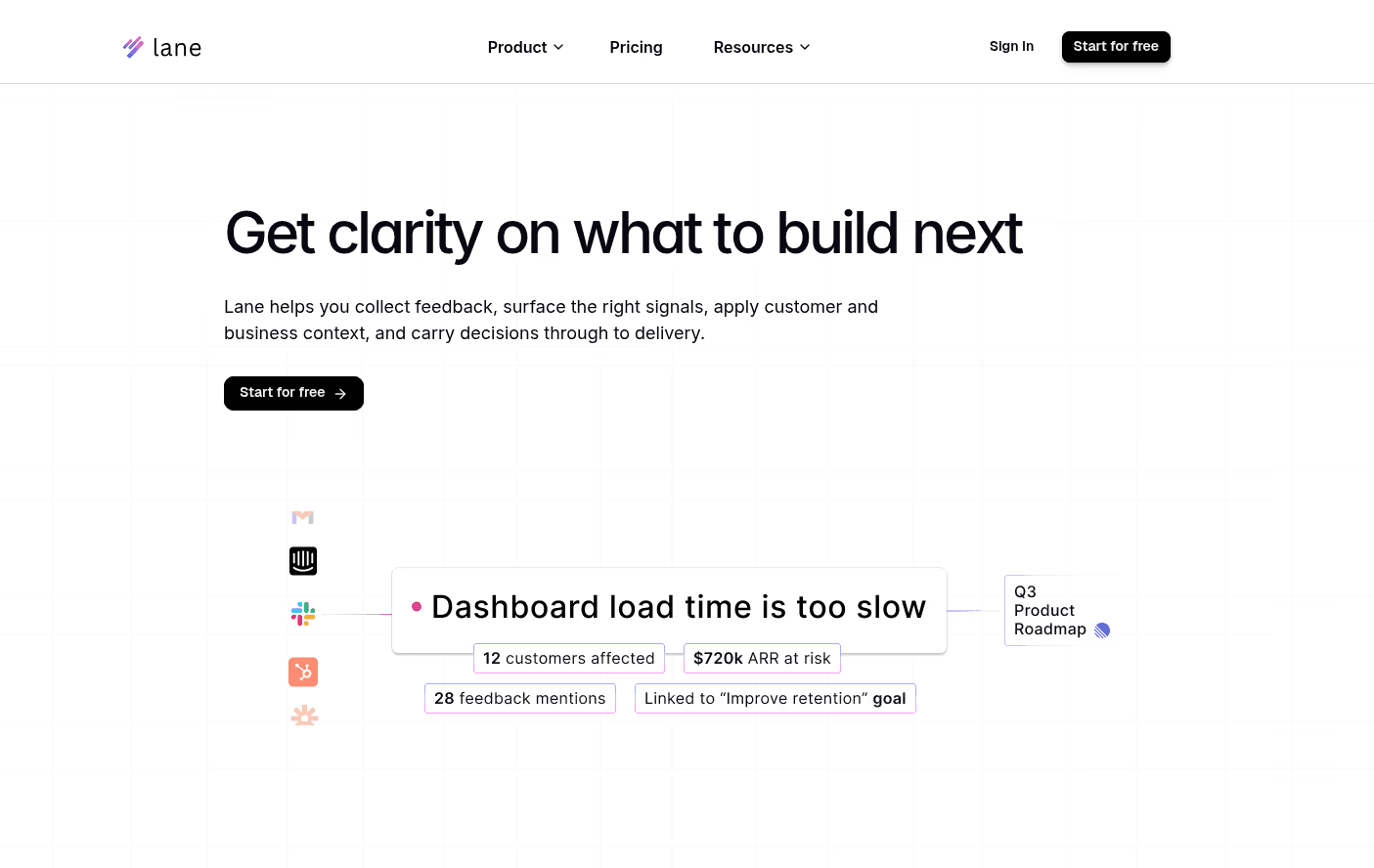

The landing page for Lane, one of the leading Productboard alternatives for B2B SaaS teams.

The landing page for Lane, one of the leading Productboard alternatives for B2B SaaS teams.

When you start exploring Productboard alternatives for B2B SaaS, you're not just looking for a different feature list. You're looking for a different way of working. That's where Lane fits in.

A modern platform for building what matters

Founded in 2024, Lane is a product discovery platform built to give teams clarity on what to build next. Its goal is simple: bring together customer feedback, business goals, and strategic priorities into one place. This makes sure every product decision is based on real customer needs and measurable business impact, not just the loudest person in the room or a gut feeling.

The intelligent layer above your execution tools

Here’s what makes Lane’s approach different: it doesn't try to replace the tools your engineering team already knows and loves. As their FAQ states, Lane is designed to sit above execution tools like Jira or Linear.

Think of it this way: Jira and Linear are great for managing the shipping of features. They track sprints, handle tickets, and keep development on schedule. Lane, on the other hand, helps you decide what to ship in the first place. It makes sure the work that lands in your engineering backlog is the most valuable, impactful work you could be doing. It’s all about making smarter bets before anyone writes a single line of code.
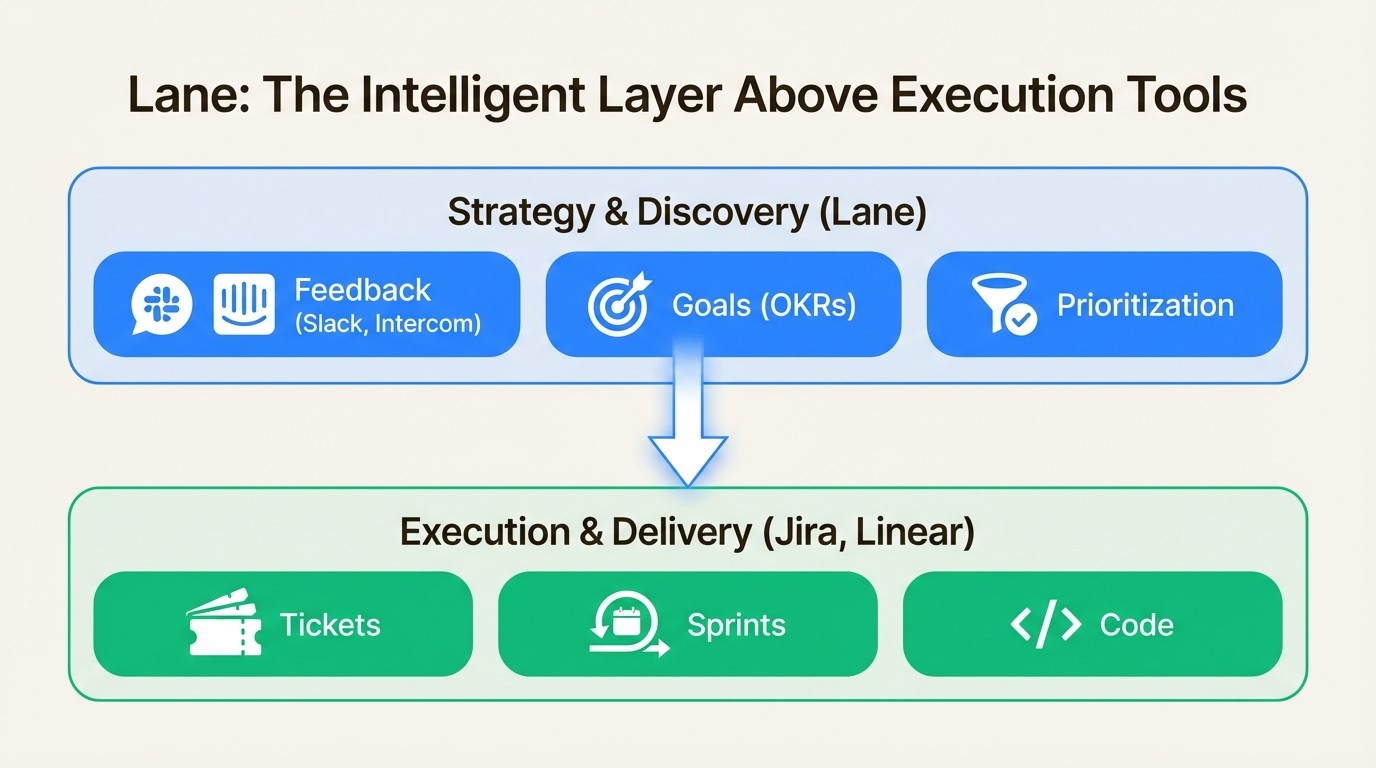
An infographic explaining how Lane works as an intelligent layer above execution tools like Jira, a key feature for Productboard alternatives for B2B SaaS.

An infographic explaining how Lane works as an intelligent layer above execution tools like Jira, a key feature for Productboard alternatives for B2B SaaS.

Key features of Lane

So, how does Lane actually help with the day-to-day grind of a B2B product team? It boils down to a few core features designed to find the signal in the noise.

Capture feedback with its full, original context

We’ve all seen it happen. A customer shares a brilliant idea in a long Slack thread, and by the time someone copies it into a spreadsheet, all the nuance is gone. The emotion, the follow-up questions, that "aha!" moment, it all disappears.

Lane addresses this by integrating directly with tools where conversations happen, like Slack, Intercom, and email. Its best feature here is the ability to capture entire Slack threads, not just one message. This keeps the full, unfiltered customer voice intact. When you look at that feedback weeks later, you get the complete picture, not just a watered-down summary.

Turn raw feedback into clear signals with built-in intelligence

Capturing feedback is only the beginning. The real challenge is making sense of it all. Instead of leaving you to manually tag everything, Lane’s "Intelligence" feature does the heavy lifting for you.

It uses AI to provide sentiment detection, insight summarization, and type detection, instantly classifying feedback as a bug, feature request, or general idea. This lets you and your team spend less time on tedious admin work and more time understanding the themes popping up from your customers. It's like having a junior product analyst on your team 24/7.

Prioritize opportunities with business and customer context

What’s the most important thing to build next? Is it the feature requested by the most users? Or the one requested by your highest-paying customers? Without context, prioritization is just a guessing game.

Lane connects feedback to the data that actually matters. You can prioritize opportunities based on customer segments, tiers, and even link them to revenue. This shifts your decision-making from subjective to data-informed. You can confidently answer "why are we building this?" with hard data that ties directly to your business goals.

Create dynamic roadmaps for clear alignment

Static roadmaps in spreadsheets or slide decks are obsolete the second you finish them. Lane’s roadmaps are living documents that always reflect your team's latest priorities. With flexible Board, Timeline, and Now-Next-Later views, you can share your plan in the format that works best for your audience.

Even better, you can create and share Public Roadmaps with just a link. This is a huge help for keeping customers and internal teams in the loop, building trust, and closing the feedback loop without any extra work.

Augment your workflow with seamless integrations

Bringing in a new tool shouldn't mean your team has to ditch their favorite apps. Lane is built to augment, not replace. With deep integrations for Linear, Jira, Slack, and Intercom, plus a handy Chrome extension for grabbing ideas from anywhere online, it slots right into your existing setup.

This approach makes adoption much smoother. Your product team gets the strategic layer they need, and your engineering team can stick to their preferred tool without any disruption.

How Lane differs from other product tools

When you survey the landscape of product management tools, you'll find plenty of powerful options. But Lane's focused approach has a few unique advantages that are clicking with fast-moving B2B SaaS teams.

A single, unified workflow from feedback to delivery

In many companies, the product workflow is fragmented. Feedback lives in one system, roadmaps are in another, and company goals are tracked somewhere else entirely. This creates silos, leads to a lot of manual copy-pasting, and guarantees that context gets lost.

Lane is designed to connect these stages. It creates a clear, traceable line from a customer request in Intercom, through prioritization against company OKRs, all the way to the feature ticket in Linear. This unified view keeps everyone on the same page and ensures the "why" behind every feature is never forgotten.
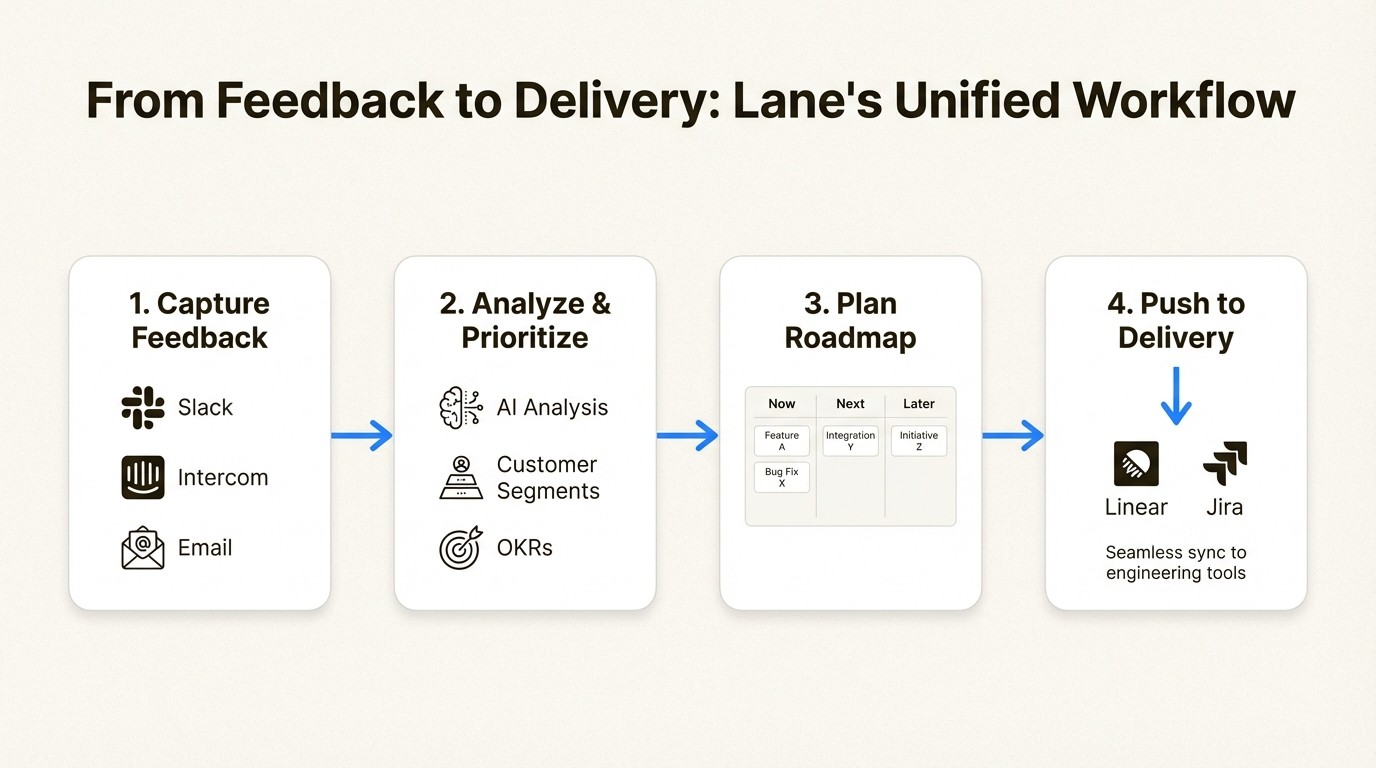
A workflow diagram showing Lane's process from feedback to delivery, a feature for Productboard alternatives for B2B SaaS.

A workflow diagram showing Lane's process from feedback to delivery, a feature for Productboard alternatives for B2B SaaS.

Specialized AI that understands product management

While many tools use AI, its application can differ. Lane doesn't use a generic model for writing marketing copy. It’s a strategic decision layer built specifically for the challenges of product discovery.

Its AI is trained to do one thing really well: find meaningful signals in unstructured customer feedback. It can tell the difference between a bug report and a feature idea, detect urgency in a customer's tone, and group related feedback into actionable themes. For teams without dedicated data analysts, this is a powerful way to turn qualitative noise into clear, quantitative insights.

A pricing model that supports collaboration

A common consideration with some established tools is pricing that can affect collaboration. Productboard, for example, uses a "per-maker" model. You can have unlimited free "contributors" and "viewers," who have limited permissions. If you want more people from customer success, sales, or support to have full rights to organize insights, you have to pay for more expensive maker seats.

Lane offers a simpler, more inclusive per-user model. This encourages everyone in the company to participate. When your customer success manager can directly capture and triage feedback with full context, the quality of your product inputs goes way up. It’s a model built for modern, cross-functional teams, not siloed departments.

Who is Lane for?

So, is Lane the right tool for your team? It's really designed for a specific type of company and a few key roles that need clarity and efficiency.

The ideal company profile

Lane really hits its stride in product-led startups and scaling SMBs in the B2B SaaS space. These are companies where every development cycle is critical, and every feature has to align with customer needs and revenue goals. If you've outgrown spreadsheets for product management but don't require the feature depth of a complex enterprise suite, Lane was built for you.

The key roles that benefit

While the whole company benefits from smarter product decisions, a few roles feel the impact right away:

  • Product Managers & Product Ops: They get a single source of truth to connect strategy with execution. This lets them prioritize with data-backed confidence and communicate plans without ambiguity.

  • Founders & CPOs: They get a high-level view of what customers are asking for and how product work ties back to company objectives, making sure the team is building the right thing.

  • Customer Success, Support, & Sales: These customer-facing teams have an easy way to capture rich feedback and see their insights influence the roadmap. It closes the loop and makes them feel heard.

Pricing comparison: Lane vs. Productboard

When you're picking a tool, price is always part of the conversation. Both Lane and Productboard have free plans, but they're built around different ideas and limitations, which you'll notice as you scale.

How Lane and Productboard structure their plans

Lane's free plan is meant to give small teams access to its core intelligence and collaboration features from day one. Productboard's free plan, while offering a customer portal, has a much tighter limit on the number of feedback notes you can process, which can push you toward a paid plan faster as your feedback volume increases.

Here's a quick look at how their entry-level and main paid plans stack up:

Feature

Lane (Starter Plan)

Productboard (Starter Plan)

Lane (Business Plan)

Productboard (Pro Plan)

Price

Free Forever

Free Forever

$19/user/month (annual)

$59/maker/month (annual)

Users/Seats

Up to 3 team members

Unlimited contributors/viewers

Unlimited collaborators

Starts at 2 makers

Feedback Limit

Up to 100 insights

50 feedback notes

Unlimited insights

Unlimited feedback notes

Core AI

AI summaries, sentiment, and type detection

Not specified on plan

All core AI features

Trended reporting, manual segments

Integrations

Linear, Slack, Jira, Intercom and more

20+ integrations

Advanced Linear & Jira sync

Salesforce integration (Enterprise)

Key Feature

Full-featured for growing teams

Customer feedback portal

Revenue context & OKRs

Advanced reporting

Pricing and features are based on information available as of January 2026 from Lane's pricing page and Productboard's pricing page.
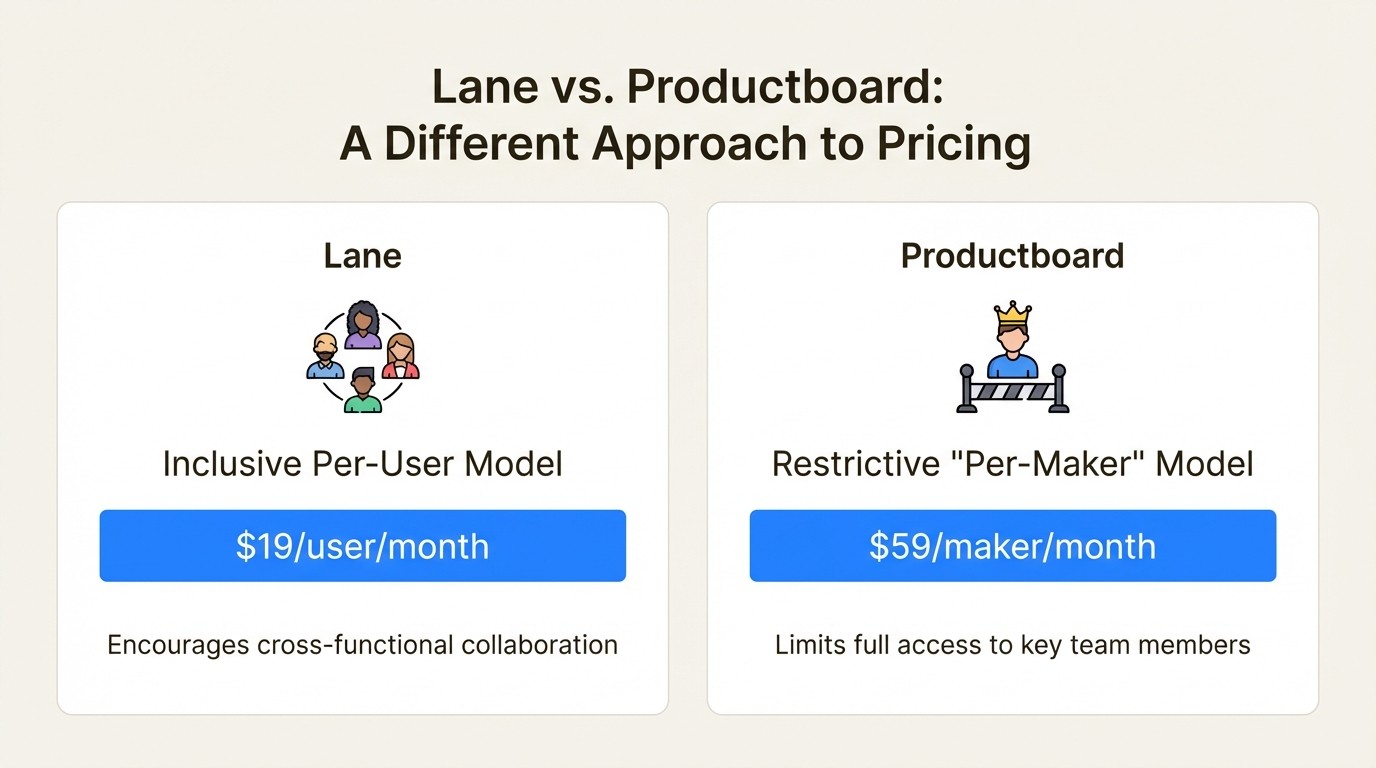
An infographic comparing the pricing models of Lane and Productboard, highlighting key differences for teams seeking Productboard alternatives for B2B SaaS.

An infographic comparing the pricing models of Lane and Productboard, highlighting key differences for teams seeking Productboard alternatives for B2B SaaS.

Choosing the right product management tool

Picking the right product management tool is a big decision. For growing B2B SaaS companies, the trick is finding a platform that's powerful enough to give you real clarity but not so complicated that it slows you down. Some enterprise-focused tools are powerful, but they often come with a steep learning curve and a price tag that can get in the way of collaboration.

Lane offers a different approach. It’s an intelligent, streamlined, and collaborative platform that gives you confidence by connecting raw customer feedback directly to your product strategy and execution. It helps you answer the most important question in product management, "What should we build next?", not with guesswork, but with data.

If you are exploring new workflows and want to try a smarter way to build products, give Lane a look. You can sign up for the free Starter plan today and see for yourself how an integrated, intelligent system can help you make better decisions, faster.

Frequently Asked Questions

What should I look for in Productboard alternatives B2B SaaS?

You should look for tools that integrate smoothly with your existing workflow (like Slack and Jira), offer intelligent features to analyze feedback automatically, and have a pricing model that encourages team-wide collaboration, not just a few "maker" seats.

Why are so many companies looking for Productboard alternatives B2B SaaS?

Many growing B2B SaaS teams find that while Productboard is powerful, it can be complex, have a steep learning curve, and its ["per-maker" pricing can become costly](https://www.reddit.com/r/SaaS/comments/1izjeq1/can_anyone_recommend_me_better_tool_than/) as more team members need to manage product insights. They're seeking more streamlined, collaborative, and intelligent solutions.

How does Lane stand out among other Productboard alternatives B2B SaaS?

Lane's approach is to be an "intelligent layer" that works *with* your existing tools like Jira or Linear, not against them. It excels at capturing full context from feedback (like entire Slack threads) and uses specialized AI to turn that raw data into clear signals for what to build next.

Are there any free Productboard alternatives B2B SaaS?

Yes, several tools offer free plans. Lane, for example, has a free Starter plan that includes core features like AI-powered insight analysis and integrations for up to three team members, making it a great option for small teams to get started.

What's the biggest benefit of using specialized Productboard alternatives B2B SaaS for product discovery?

The biggest benefit is clarity. Instead of guessing what to build based on gut feelings or the loudest voice, these tools connect real customer feedback to business goals. This allows you to make data-informed decisions, ensuring your engineering team is always working on the most impactful features.

Can Productboard alternatives B2B SaaS help with creating public roadmaps?

Absolutely. Modern alternatives like Lane make it easy to create and share [dynamic public roadmaps](https://support.productboard.com/hc/en-us/articles/25194944993939-Timeline-boards-Flexible-time-based-roadmaps) with a simple link. This is a fantastic way to keep your customers and internal stakeholders aligned, build trust, and close the feedback loop.

Why product teams are exploring new tools

If you're part of a modern B2B SaaS product team, you know the feeling: information is coming at you from all sides. Customer feedback is piling up in Slack, sales call notes are scattered in shared docs, and support tickets are stacking up in Intercom. You know there are golden nuggets of insight in that mountain of data, but finding them feels like a whole separate job. And all this is happening while you’re expected to make high-impact decisions, and fast.

For a long time, powerful platforms were the answer to this chaos. A tool like Productboard, which is trusted by over 6,000 companies, gives you a solid way to manage ideas and build roadmaps. But for many growing teams, this level of functionality can introduce complexity. The learning curve can be pretty steep, and pricing models that limit the number of "makers" can feel restrictive when you want everyone, from customer success to sales, to chip in.

This has pushed teams to look for a new kind of product management tool, one that’s more streamlined, intelligent, and collaborative. They're searching for an intelligent layer that fits into their existing workflows instead of forcing them to start from scratch. They need a tool that connects the dots for them, not one that just gives them more dots to connect by hand.

This is the exact problem we set out to solve with Lane. We designed it to be that intelligent layer, linking scattered feedback to a clear strategy so you can build what really matters, without the complexity of a larger system.

What is Lane? An intelligent layer for product management


The landing page for Lane, one of the leading Productboard alternatives for B2B SaaS teams.

The landing page for Lane, one of the leading Productboard alternatives for B2B SaaS teams.

When you start exploring Productboard alternatives for B2B SaaS, you're not just looking for a different feature list. You're looking for a different way of working. That's where Lane fits in.

A modern platform for building what matters

Founded in 2024, Lane is a product discovery platform built to give teams clarity on what to build next. Its goal is simple: bring together customer feedback, business goals, and strategic priorities into one place. This makes sure every product decision is based on real customer needs and measurable business impact, not just the loudest person in the room or a gut feeling.

The intelligent layer above your execution tools

Here’s what makes Lane’s approach different: it doesn't try to replace the tools your engineering team already knows and loves. As their FAQ states, Lane is designed to sit above execution tools like Jira or Linear.

Think of it this way: Jira and Linear are great for managing the shipping of features. They track sprints, handle tickets, and keep development on schedule. Lane, on the other hand, helps you decide what to ship in the first place. It makes sure the work that lands in your engineering backlog is the most valuable, impactful work you could be doing. It’s all about making smarter bets before anyone writes a single line of code.

An infographic explaining how Lane works as an intelligent layer above execution tools like Jira, a key feature for Productboard alternatives for B2B SaaS.

An infographic explaining how Lane works as an intelligent layer above execution tools like Jira, a key feature for Productboard alternatives for B2B SaaS.

Key features of Lane

So, how does Lane actually help with the day-to-day grind of a B2B product team? It boils down to a few core features designed to find the signal in the noise.

Capture feedback with its full, original context

We’ve all seen it happen. A customer shares a brilliant idea in a long Slack thread, and by the time someone copies it into a spreadsheet, all the nuance is gone. The emotion, the follow-up questions, that "aha!" moment, it all disappears.

Lane addresses this by integrating directly with tools where conversations happen, like Slack, Intercom, and email. Its best feature here is the ability to capture entire Slack threads, not just one message. This keeps the full, unfiltered customer voice intact. When you look at that feedback weeks later, you get the complete picture, not just a watered-down summary.

Turn raw feedback into clear signals with built-in intelligence

Capturing feedback is only the beginning. The real challenge is making sense of it all. Instead of leaving you to manually tag everything, Lane’s "Intelligence" feature does the heavy lifting for you.

It uses AI to provide sentiment detection, insight summarization, and type detection, instantly classifying feedback as a bug, feature request, or general idea. This lets you and your team spend less time on tedious admin work and more time understanding the themes popping up from your customers. It's like having a junior product analyst on your team 24/7.

Prioritize opportunities with business and customer context

What’s the most important thing to build next? Is it the feature requested by the most users? Or the one requested by your highest-paying customers? Without context, prioritization is just a guessing game.

Lane connects feedback to the data that actually matters. You can prioritize opportunities based on customer segments, tiers, and even link them to revenue. This shifts your decision-making from subjective to data-informed. You can confidently answer "why are we building this?" with hard data that ties directly to your business goals.

Create dynamic roadmaps for clear alignment

Static roadmaps in spreadsheets or slide decks are obsolete the second you finish them. Lane’s roadmaps are living documents that always reflect your team's latest priorities. With flexible Board, Timeline, and Now-Next-Later views, you can share your plan in the format that works best for your audience.

Even better, you can create and share Public Roadmaps with just a link. This is a huge help for keeping customers and internal teams in the loop, building trust, and closing the feedback loop without any extra work.

Augment your workflow with seamless integrations

Bringing in a new tool shouldn't mean your team has to ditch their favorite apps. Lane is built to augment, not replace. With deep integrations for Linear, Jira, Slack, and Intercom, plus a handy Chrome extension for grabbing ideas from anywhere online, it slots right into your existing setup.

This approach makes adoption much smoother. Your product team gets the strategic layer they need, and your engineering team can stick to their preferred tool without any disruption.

How Lane differs from other product tools

When you survey the landscape of product management tools, you'll find plenty of powerful options. But Lane's focused approach has a few unique advantages that are clicking with fast-moving B2B SaaS teams.

A single, unified workflow from feedback to delivery

In many companies, the product workflow is fragmented. Feedback lives in one system, roadmaps are in another, and company goals are tracked somewhere else entirely. This creates silos, leads to a lot of manual copy-pasting, and guarantees that context gets lost.

Lane is designed to connect these stages. It creates a clear, traceable line from a customer request in Intercom, through prioritization against company OKRs, all the way to the feature ticket in Linear. This unified view keeps everyone on the same page and ensures the "why" behind every feature is never forgotten.

A workflow diagram showing Lane's process from feedback to delivery, a feature for Productboard alternatives for B2B SaaS.

A workflow diagram showing Lane's process from feedback to delivery, a feature for Productboard alternatives for B2B SaaS.

Specialized AI that understands product management

While many tools use AI, its application can differ. Lane doesn't use a generic model for writing marketing copy. It’s a strategic decision layer built specifically for the challenges of product discovery.

Its AI is trained to do one thing really well: find meaningful signals in unstructured customer feedback. It can tell the difference between a bug report and a feature idea, detect urgency in a customer's tone, and group related feedback into actionable themes. For teams without dedicated data analysts, this is a powerful way to turn qualitative noise into clear, quantitative insights.

A pricing model that supports collaboration

A common consideration with some established tools is pricing that can affect collaboration. Productboard, for example, uses a "per-maker" model. You can have unlimited free "contributors" and "viewers," who have limited permissions. If you want more people from customer success, sales, or support to have full rights to organize insights, you have to pay for more expensive maker seats.

Lane offers a simpler, more inclusive per-user model. This encourages everyone in the company to participate. When your customer success manager can directly capture and triage feedback with full context, the quality of your product inputs goes way up. It’s a model built for modern, cross-functional teams, not siloed departments.

Who is Lane for?

So, is Lane the right tool for your team? It's really designed for a specific type of company and a few key roles that need clarity and efficiency.

The ideal company profile

Lane really hits its stride in product-led startups and scaling SMBs in the B2B SaaS space. These are companies where every development cycle is critical, and every feature has to align with customer needs and revenue goals. If you've outgrown spreadsheets for product management but don't require the feature depth of a complex enterprise suite, Lane was built for you.

The key roles that benefit

While the whole company benefits from smarter product decisions, a few roles feel the impact right away:

  • Product Managers & Product Ops: They get a single source of truth to connect strategy with execution. This lets them prioritize with data-backed confidence and communicate plans without ambiguity.

  • Founders & CPOs: They get a high-level view of what customers are asking for and how product work ties back to company objectives, making sure the team is building the right thing.

  • Customer Success, Support, & Sales: These customer-facing teams have an easy way to capture rich feedback and see their insights influence the roadmap. It closes the loop and makes them feel heard.

Pricing comparison: Lane vs. Productboard

When you're picking a tool, price is always part of the conversation. Both Lane and Productboard have free plans, but they're built around different ideas and limitations, which you'll notice as you scale.

How Lane and Productboard structure their plans

Lane's free plan is meant to give small teams access to its core intelligence and collaboration features from day one. Productboard's free plan, while offering a customer portal, has a much tighter limit on the number of feedback notes you can process, which can push you toward a paid plan faster as your feedback volume increases.

Here's a quick look at how their entry-level and main paid plans stack up:

Feature

Lane (Starter Plan)

Productboard (Starter Plan)

Lane (Business Plan)

Productboard (Pro Plan)

Price

Free Forever

Free Forever

$19/user/month (annual)

$59/maker/month (annual)

Users/Seats

Up to 3 team members

Unlimited contributors/viewers

Unlimited collaborators

Starts at 2 makers

Feedback Limit

Up to 100 insights

50 feedback notes

Unlimited insights

Unlimited feedback notes

Core AI

AI summaries, sentiment, and type detection

Not specified on plan

All core AI features

Trended reporting, manual segments

Integrations

Linear, Slack, Jira, Intercom and more

20+ integrations

Advanced Linear & Jira sync

Salesforce integration (Enterprise)

Key Feature

Full-featured for growing teams

Customer feedback portal

Revenue context & OKRs

Advanced reporting

Pricing and features are based on information available as of January 2026 from Lane's pricing page and Productboard's pricing page.

An infographic comparing the pricing models of Lane and Productboard, highlighting key differences for teams seeking Productboard alternatives for B2B SaaS.

An infographic comparing the pricing models of Lane and Productboard, highlighting key differences for teams seeking Productboard alternatives for B2B SaaS.

Choosing the right product management tool

Picking the right product management tool is a big decision. For growing B2B SaaS companies, the trick is finding a platform that's powerful enough to give you real clarity but not so complicated that it slows you down. Some enterprise-focused tools are powerful, but they often come with a steep learning curve and a price tag that can get in the way of collaboration.

Lane offers a different approach. It’s an intelligent, streamlined, and collaborative platform that gives you confidence by connecting raw customer feedback directly to your product strategy and execution. It helps you answer the most important question in product management, "What should we build next?", not with guesswork, but with data.

If you are exploring new workflows and want to try a smarter way to build products, give Lane a look. You can sign up for the free Starter plan today and see for yourself how an integrated, intelligent system can help you make better decisions, faster.

Frequently Asked Questions

What should I look for in Productboard alternatives B2B SaaS?

You should look for tools that integrate smoothly with your existing workflow (like Slack and Jira), offer intelligent features to analyze feedback automatically, and have a pricing model that encourages team-wide collaboration, not just a few "maker" seats.

Why are so many companies looking for Productboard alternatives B2B SaaS?

Many growing B2B SaaS teams find that while Productboard is powerful, it can be complex, have a steep learning curve, and its ["per-maker" pricing can become costly](https://www.reddit.com/r/SaaS/comments/1izjeq1/can_anyone_recommend_me_better_tool_than/) as more team members need to manage product insights. They're seeking more streamlined, collaborative, and intelligent solutions.

How does Lane stand out among other Productboard alternatives B2B SaaS?

Lane's approach is to be an "intelligent layer" that works *with* your existing tools like Jira or Linear, not against them. It excels at capturing full context from feedback (like entire Slack threads) and uses specialized AI to turn that raw data into clear signals for what to build next.

Are there any free Productboard alternatives B2B SaaS?

Yes, several tools offer free plans. Lane, for example, has a free Starter plan that includes core features like AI-powered insight analysis and integrations for up to three team members, making it a great option for small teams to get started.

What's the biggest benefit of using specialized Productboard alternatives B2B SaaS for product discovery?

The biggest benefit is clarity. Instead of guessing what to build based on gut feelings or the loudest voice, these tools connect real customer feedback to business goals. This allows you to make data-informed decisions, ensuring your engineering team is always working on the most impactful features.

Can Productboard alternatives B2B SaaS help with creating public roadmaps?

Absolutely. Modern alternatives like Lane make it easy to create and share [dynamic public roadmaps](https://support.productboard.com/hc/en-us/articles/25194944993939-Timeline-boards-Flexible-time-based-roadmaps) with a simple link. This is a fantastic way to keep your customers and internal stakeholders aligned, build trust, and close the feedback loop.

Expected a CTA? We're are working on it.

If you are still not convinced, give lane a try yourself.

Expected a CTA? We're are working on it.

If you are still not convinced, give lane a try yourself.