Aug 2, 2026
Articles
How does customer feedback become a product decision?
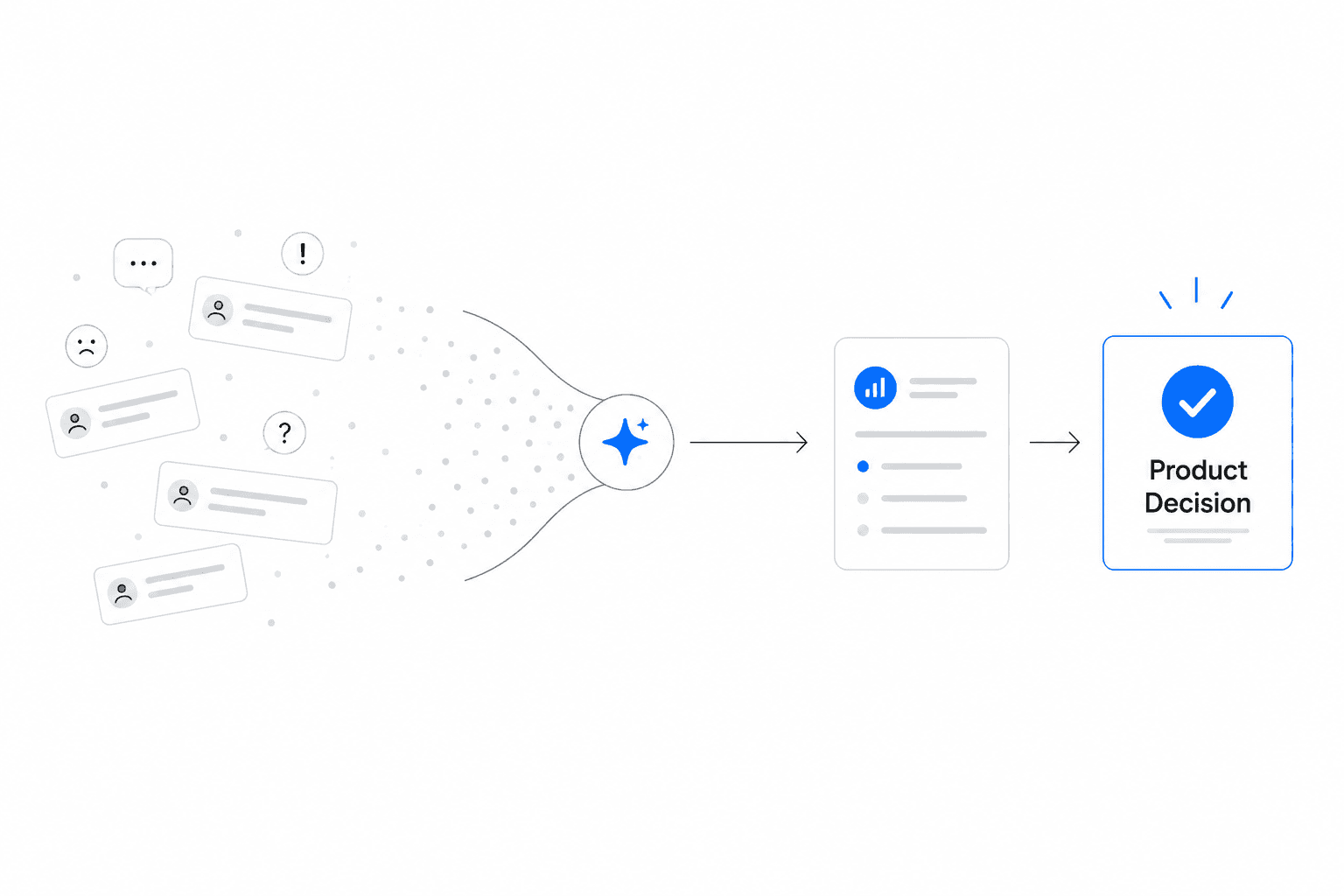
Customer feedback becomes a product decision through four transformations: raw feedback is split into individual insights, insights are grouped into signals that represent a recurring problem, signals are weighted by who is affected and what it costs, and the surviving signals become plans. Most teams collect feedback well and stall at the second step.
Almost every B2B SaaS team has solved collection. Feedback arrives through Intercom, Zendesk, sales calls, Slack channels shared with customers, CRM notes, and the occasional founder DM. The pipes work. What breaks is everything after the pipes.
The gap is not effort. It is that "feedback" and "decision" are different kinds of object, and nothing automatically converts one into the other. A support ticket is a single person describing a single moment. A roadmap item is a claim about many people over time. Getting from one to the other requires a sequence of transformations, and each transformation can be done well or badly.
This post walks through those transformations, including how we implement them inside Lane, because the implementation details are where most of the real difficulty lives. If you are building this yourself, the tradeoffs below are the ones you will hit.
Why does feedback fail to become a decision?
Feedback fails to convert for four reasons, and only one of them is about volume.
The unit is wrong. A single feedback item usually contains more than one idea. A support conversation might contain a bug report, a workflow complaint, and a passing wish for an integration. Stored as one record, it can only be tagged as one thing. Whatever tag you pick, you have thrown away the other two. Multiply this across a year of tickets and the archive is quietly lossy in a way no dashboard will show you.
The same problem arrives in different words. "Dispatchers can't reassign a route once a shift starts" and "we have to call drivers directly when plans change mid-day" are the same underlying problem described by two people with different vocabularies. Keyword grouping will never join them. Tag-based systems will not either, because the two people who logged them chose different tags. The problem looks like two small complaints instead of one significant one.
Nobody knows who is behind a request. Ten upvotes from ten trial accounts and three requests from three renewing enterprise accounts are not comparable, but a raw count treats them identically. Without account context attached at the point of capture, prioritisation degrades into counting.
The decision is never traced back. Even when a good decision is made, the person who reported the original problem rarely hears about it. The loop stays open, they stop reporting, and your input volume quietly declines while you congratulate yourself on shipping.
Notice that none of these are solved by collecting more. They are solved by transforming better.
What has to happen between a support ticket and a roadmap item?
Four transformations, in order. Each one changes what kind of object you are holding.
Feedback → Insights. Split the raw item into its individual claims. One conversation may yield four insights or zero. This is the step that fixes the wrong-unit problem, and it has to happen before anything else, because every downstream step operates on insights rather than on the original blob.
Insights → Signals. Group insights that describe the same underlying problem, regardless of wording. A signal is not a tag and not a feature request. It is a claim that a specific problem recurs across specific accounts. This is the hardest step and the one most systems skip.
Signals → Weighted signals. Attach who is affected, what they pay, whether they are approaching renewal, and how the signal is trending. A signal that has doubled in a month is a different object from one that has been flat for a year at the same volume.
Weighted signals → Plans. Turn the surviving signals into something a team can build against, with the underlying evidence still attached so the reasoning survives contact with a stakeholder who asks why.
The reason to name these separately is that teams routinely collapse them. Collapsing steps one and two produces tag soup. Collapsing two and three produces a leaderboard of whoever shouts loudest. Collapsing three and four produces a roadmap nobody can defend six weeks later.
How do you split feedback without losing what was said?
Splitting sounds mechanical and is not.
The naive approach processes feedback line by line, which fails immediately on anything conversational. Context that establishes what a complaint means often sits several sentences away from the complaint itself. So the first rule is that the model reads the entire piece of feedback before it extracts anything. Comprehension first, extraction second.
The second rule concerns transcripts specifically, and it matters more than it sounds. In a sales call or a support call, only one side of the conversation is the customer. If you extract from the whole transcript, you will end up recording your own team's speculation as customer feedback. "So it sounds like you'd want bulk editing?" is a sales rep's hypothesis, not a customer request, and once it enters the pipeline as an insight it is indistinguishable from one. In Lane, transcript-type feedback identifies the external customer voice and extracts only from those turns, using internal turns as context. Without that rule, a system will confidently manufacture demand out of its own team's questions.
The third rule is verbatim fidelity. Each insight carries the exact span of text it came from, not a paraphrase. Paraphrase at extraction time compounds through every later stage, and by the time it reaches a plan, nobody can tell what the customer actually said. It also makes the closing-the-loop step impossible, because you cannot show a customer a summary of a summary and expect them to recognise their own words.
The failure mode worth naming here is entity fabrication. When you ask a model to summarise feedback, it will sometimes introduce specifics that were never present — a company name, a number, a role. We found this in evaluation runs across our splitter and signal summary prompts, and it is the single most damaging error in a feedback pipeline, because a fabricated specific is more convincing than a vague truth. Anyone building this should be testing for it explicitly rather than assuming a good prompt prevents it.
How do you tell a real pattern from a coincidence?
This is where most implementations either give up or overreach.
Two insights describing the same problem in different words need to end up in the same signal. Two insights that merely share vocabulary need to stay apart. Keyword matching gets this wrong in both directions. Pure semantic similarity gets it wrong in one: embeddings will happily cluster things that are topically adjacent but operationally unrelated.
Three implementation choices matter.
Canonicalise before embedding. Raw feedback text carries noise — greetings, ticket boilerplate, the customer's own hedging — that pollutes the vector. Rewriting each insight into a canonical form before embedding produces meaningfully cleaner grouping than embedding raw text. This is unglamorous and has more effect than any model choice.
Use hybrid retrieval, not vector search alone. Vector search is good at meaning and bad at exact terms; lexical search is the reverse. A customer who names a specific competitor, a specific error code, or a specific integration needs that term matched exactly. We combine Atlas Search and $vectorSearch and fuse the results with reciprocal rank fusion. Either method alone leaves a visible class of misses.
Band your confidence, and treat the middle differently. Not every match deserves the same treatment. Above roughly 0.9 similarity, the insight links directly to the existing signal with no further work. Between roughly 0.6 and 0.9, the top candidate signals are passed to a model that decides which one actually fits, or whether none do. Below that band, the insight seeds a new signal. The middle band is where all the judgment lives, and it is the band that automatic clustering handles worst.
One consequence of doing this at the insight level rather than the document level: a single piece of feedback can legitimately attach to two different signals, each with its own verbatim span and its own confidence. The message that says the app is slow and the checkout button is missing belongs in two places. Document-level tagging cannot express that.
A further choice worth flagging is incremental assignment versus nightly re-clustering. Re-clustering the whole corpus every night produces cleaner groupings in theory and unstable ones in practice — signals shift underneath the team, and a signal someone cited in a meeting on Tuesday has been reshaped by Thursday. Assigning incrementally as feedback arrives is slightly less optimal and considerably more trustworthy. Trust matters more here than optimality.
What makes a product decision defensible?
A decision is defensible when the person questioning it can be shown the evidence without you reconstructing it from memory.
That requires the chain to stay intact end to end: plan → signals → insights → original feedback → the account and the person who said it. If any link is missing, the decision becomes an assertion. Assertions lose arguments with sales.
It also requires the weighting to be visible rather than implicit. "Three enterprise accounts, two approaching renewal, raised this across eleven separate conversations in six weeks" is a defensible sentence. "This is highly requested" is not, and it is the sentence most roadmaps are actually built on.
The last part is closing the loop back into the source channel. When something ships, the reply should land where the feedback originated — the Intercom thread, the Slack channel, the CRM record — not in a changelog the customer will never read. This is the step that keeps the input flowing, and it is the one teams cut first when they are busy.
The four stages, compared
Stage | Object | What it answers | Common failure |
|---|---|---|---|
Capture | Feedback | What did someone say, and who are they? | Account context not attached at capture time |
Extract | Insights | What distinct claims were made? | Line-by-line processing; paraphrasing away the original wording |
Group | Signals | Which problem recurs, across whom? | Keyword or tag grouping; unstable nightly re-clustering |
Weight & decide | Plans | What is worth building, and why? | Raw vote counts standing in for revenue and renewal context |
When this doesn't apply
This model is built for teams with more feedback than one person can hold in their head, arriving through more than two channels. Below that threshold it is overhead.
If you have twenty customers and talk to all of them, you already have the signal. Formalising the pipeline will slow you down and tell you things you knew. The honest advice for early-stage teams is to read everything yourself for as long as that remains possible.
It also does not apply cleanly to genuinely novel products with no comparable prior art. Feedback tells you about problems inside the frame customers already understand. It will not tell you to build the thing they cannot yet imagine asking for. Teams working on that kind of product should treat this pipeline as one input among several rather than the primary one.
And it does not remove judgment. A well-weighted signal narrows the field; it does not pick. Anyone claiming a system converts feedback into decisions without a human deciding is selling something.
Frequently asked questions
1. What is the difference between feedback, an insight, and a signal? Feedback is the raw thing a customer said. An insight is one distinct claim extracted from it, kept verbatim. A signal is a group of insights across multiple accounts describing the same underlying problem. Feedback is an event, an insight is a unit, and a signal is a pattern.
2. Can this be done with tags instead of embeddings? Partially. Tagging works when your problem space is small and stable and the same person tags everything. It breaks when different people use different tags for the same problem, or when a problem you have no tag for starts recurring. Tags cannot discover categories; they can only apply existing ones.
3. How is this different from what Productboard or Canny do? Both are strong at collection and at giving customers a visible place to submit and vote. Canny's public boards are particularly effective for community-driven products. The distinction is where the work sits: voting boards aggregate what customers explicitly submit, while this model extracts signals from conversations customers never intended as submissions.
4. Does closing the loop actually change anything? Yes, mainly on the input side. Customers who see their reports acted on keep reporting; customers who never hear back stop. Since the quality of every downstream decision depends on input volume and honesty, the loop is not a courtesy feature — it is what keeps the pipeline supplied.
5. How much feedback do you need before this is worth building? Roughly the point at which no single person can read everything that arrives in a week. Below that, a shared document and a weekly read-through outperform any system. Above it, the loss from unread feedback compounds quietly and you will not notice it happening.
6. Does this replace talking to customers? No. It changes which conversations you have. A pipeline surfaces which problems recur and across which accounts, which means interviews can start from a specific hypothesis rather than from open-ended discovery. The interview stays essential; it just stops being the discovery mechanism of first resort.
Lane is built on this model — feedback becomes insights, insights become signals, signals become plans — and sits above your issue tracker rather than replacing it.
Customer feedback becomes a product decision through four transformations: raw feedback is split into individual insights, insights are grouped into signals that represent a recurring problem, signals are weighted by who is affected and what it costs, and the surviving signals become plans. Most teams collect feedback well and stall at the second step.
Almost every B2B SaaS team has solved collection. Feedback arrives through Intercom, Zendesk, sales calls, Slack channels shared with customers, CRM notes, and the occasional founder DM. The pipes work. What breaks is everything after the pipes.
The gap is not effort. It is that "feedback" and "decision" are different kinds of object, and nothing automatically converts one into the other. A support ticket is a single person describing a single moment. A roadmap item is a claim about many people over time. Getting from one to the other requires a sequence of transformations, and each transformation can be done well or badly.
This post walks through those transformations, including how we implement them inside Lane, because the implementation details are where most of the real difficulty lives. If you are building this yourself, the tradeoffs below are the ones you will hit.
Why does feedback fail to become a decision?
Feedback fails to convert for four reasons, and only one of them is about volume.
The unit is wrong. A single feedback item usually contains more than one idea. A support conversation might contain a bug report, a workflow complaint, and a passing wish for an integration. Stored as one record, it can only be tagged as one thing. Whatever tag you pick, you have thrown away the other two. Multiply this across a year of tickets and the archive is quietly lossy in a way no dashboard will show you.
The same problem arrives in different words. "Dispatchers can't reassign a route once a shift starts" and "we have to call drivers directly when plans change mid-day" are the same underlying problem described by two people with different vocabularies. Keyword grouping will never join them. Tag-based systems will not either, because the two people who logged them chose different tags. The problem looks like two small complaints instead of one significant one.
Nobody knows who is behind a request. Ten upvotes from ten trial accounts and three requests from three renewing enterprise accounts are not comparable, but a raw count treats them identically. Without account context attached at the point of capture, prioritisation degrades into counting.
The decision is never traced back. Even when a good decision is made, the person who reported the original problem rarely hears about it. The loop stays open, they stop reporting, and your input volume quietly declines while you congratulate yourself on shipping.
Notice that none of these are solved by collecting more. They are solved by transforming better.
What has to happen between a support ticket and a roadmap item?
Four transformations, in order. Each one changes what kind of object you are holding.
Feedback → Insights. Split the raw item into its individual claims. One conversation may yield four insights or zero. This is the step that fixes the wrong-unit problem, and it has to happen before anything else, because every downstream step operates on insights rather than on the original blob.
Insights → Signals. Group insights that describe the same underlying problem, regardless of wording. A signal is not a tag and not a feature request. It is a claim that a specific problem recurs across specific accounts. This is the hardest step and the one most systems skip.
Signals → Weighted signals. Attach who is affected, what they pay, whether they are approaching renewal, and how the signal is trending. A signal that has doubled in a month is a different object from one that has been flat for a year at the same volume.
Weighted signals → Plans. Turn the surviving signals into something a team can build against, with the underlying evidence still attached so the reasoning survives contact with a stakeholder who asks why.
The reason to name these separately is that teams routinely collapse them. Collapsing steps one and two produces tag soup. Collapsing two and three produces a leaderboard of whoever shouts loudest. Collapsing three and four produces a roadmap nobody can defend six weeks later.
How do you split feedback without losing what was said?
Splitting sounds mechanical and is not.
The naive approach processes feedback line by line, which fails immediately on anything conversational. Context that establishes what a complaint means often sits several sentences away from the complaint itself. So the first rule is that the model reads the entire piece of feedback before it extracts anything. Comprehension first, extraction second.
The second rule concerns transcripts specifically, and it matters more than it sounds. In a sales call or a support call, only one side of the conversation is the customer. If you extract from the whole transcript, you will end up recording your own team's speculation as customer feedback. "So it sounds like you'd want bulk editing?" is a sales rep's hypothesis, not a customer request, and once it enters the pipeline as an insight it is indistinguishable from one. In Lane, transcript-type feedback identifies the external customer voice and extracts only from those turns, using internal turns as context. Without that rule, a system will confidently manufacture demand out of its own team's questions.
The third rule is verbatim fidelity. Each insight carries the exact span of text it came from, not a paraphrase. Paraphrase at extraction time compounds through every later stage, and by the time it reaches a plan, nobody can tell what the customer actually said. It also makes the closing-the-loop step impossible, because you cannot show a customer a summary of a summary and expect them to recognise their own words.
The failure mode worth naming here is entity fabrication. When you ask a model to summarise feedback, it will sometimes introduce specifics that were never present — a company name, a number, a role. We found this in evaluation runs across our splitter and signal summary prompts, and it is the single most damaging error in a feedback pipeline, because a fabricated specific is more convincing than a vague truth. Anyone building this should be testing for it explicitly rather than assuming a good prompt prevents it.
How do you tell a real pattern from a coincidence?
This is where most implementations either give up or overreach.
Two insights describing the same problem in different words need to end up in the same signal. Two insights that merely share vocabulary need to stay apart. Keyword matching gets this wrong in both directions. Pure semantic similarity gets it wrong in one: embeddings will happily cluster things that are topically adjacent but operationally unrelated.
Three implementation choices matter.
Canonicalise before embedding. Raw feedback text carries noise — greetings, ticket boilerplate, the customer's own hedging — that pollutes the vector. Rewriting each insight into a canonical form before embedding produces meaningfully cleaner grouping than embedding raw text. This is unglamorous and has more effect than any model choice.
Use hybrid retrieval, not vector search alone. Vector search is good at meaning and bad at exact terms; lexical search is the reverse. A customer who names a specific competitor, a specific error code, or a specific integration needs that term matched exactly. We combine Atlas Search and $vectorSearch and fuse the results with reciprocal rank fusion. Either method alone leaves a visible class of misses.
Band your confidence, and treat the middle differently. Not every match deserves the same treatment. Above roughly 0.9 similarity, the insight links directly to the existing signal with no further work. Between roughly 0.6 and 0.9, the top candidate signals are passed to a model that decides which one actually fits, or whether none do. Below that band, the insight seeds a new signal. The middle band is where all the judgment lives, and it is the band that automatic clustering handles worst.
One consequence of doing this at the insight level rather than the document level: a single piece of feedback can legitimately attach to two different signals, each with its own verbatim span and its own confidence. The message that says the app is slow and the checkout button is missing belongs in two places. Document-level tagging cannot express that.
A further choice worth flagging is incremental assignment versus nightly re-clustering. Re-clustering the whole corpus every night produces cleaner groupings in theory and unstable ones in practice — signals shift underneath the team, and a signal someone cited in a meeting on Tuesday has been reshaped by Thursday. Assigning incrementally as feedback arrives is slightly less optimal and considerably more trustworthy. Trust matters more here than optimality.
What makes a product decision defensible?
A decision is defensible when the person questioning it can be shown the evidence without you reconstructing it from memory.
That requires the chain to stay intact end to end: plan → signals → insights → original feedback → the account and the person who said it. If any link is missing, the decision becomes an assertion. Assertions lose arguments with sales.
It also requires the weighting to be visible rather than implicit. "Three enterprise accounts, two approaching renewal, raised this across eleven separate conversations in six weeks" is a defensible sentence. "This is highly requested" is not, and it is the sentence most roadmaps are actually built on.
The last part is closing the loop back into the source channel. When something ships, the reply should land where the feedback originated — the Intercom thread, the Slack channel, the CRM record — not in a changelog the customer will never read. This is the step that keeps the input flowing, and it is the one teams cut first when they are busy.
The four stages, compared
Stage | Object | What it answers | Common failure |
|---|---|---|---|
Capture | Feedback | What did someone say, and who are they? | Account context not attached at capture time |
Extract | Insights | What distinct claims were made? | Line-by-line processing; paraphrasing away the original wording |
Group | Signals | Which problem recurs, across whom? | Keyword or tag grouping; unstable nightly re-clustering |
Weight & decide | Plans | What is worth building, and why? | Raw vote counts standing in for revenue and renewal context |
When this doesn't apply
This model is built for teams with more feedback than one person can hold in their head, arriving through more than two channels. Below that threshold it is overhead.
If you have twenty customers and talk to all of them, you already have the signal. Formalising the pipeline will slow you down and tell you things you knew. The honest advice for early-stage teams is to read everything yourself for as long as that remains possible.
It also does not apply cleanly to genuinely novel products with no comparable prior art. Feedback tells you about problems inside the frame customers already understand. It will not tell you to build the thing they cannot yet imagine asking for. Teams working on that kind of product should treat this pipeline as one input among several rather than the primary one.
And it does not remove judgment. A well-weighted signal narrows the field; it does not pick. Anyone claiming a system converts feedback into decisions without a human deciding is selling something.
Frequently asked questions
1. What is the difference between feedback, an insight, and a signal? Feedback is the raw thing a customer said. An insight is one distinct claim extracted from it, kept verbatim. A signal is a group of insights across multiple accounts describing the same underlying problem. Feedback is an event, an insight is a unit, and a signal is a pattern.
2. Can this be done with tags instead of embeddings? Partially. Tagging works when your problem space is small and stable and the same person tags everything. It breaks when different people use different tags for the same problem, or when a problem you have no tag for starts recurring. Tags cannot discover categories; they can only apply existing ones.
3. How is this different from what Productboard or Canny do? Both are strong at collection and at giving customers a visible place to submit and vote. Canny's public boards are particularly effective for community-driven products. The distinction is where the work sits: voting boards aggregate what customers explicitly submit, while this model extracts signals from conversations customers never intended as submissions.
4. Does closing the loop actually change anything? Yes, mainly on the input side. Customers who see their reports acted on keep reporting; customers who never hear back stop. Since the quality of every downstream decision depends on input volume and honesty, the loop is not a courtesy feature — it is what keeps the pipeline supplied.
5. How much feedback do you need before this is worth building? Roughly the point at which no single person can read everything that arrives in a week. Below that, a shared document and a weekly read-through outperform any system. Above it, the loss from unread feedback compounds quietly and you will not notice it happening.
6. Does this replace talking to customers? No. It changes which conversations you have. A pipeline surfaces which problems recur and across which accounts, which means interviews can start from a specific hypothesis rather than from open-ended discovery. The interview stays essential; it just stops being the discovery mechanism of first resort.
Lane is built on this model — feedback becomes insights, insights become signals, signals become plans — and sits above your issue tracker rather than replacing it.
Expected a CTA? We're are working on it.
If you are still not convinced, give lane a try yourself.
Expected a CTA? We're are working on it.
If you are still not convinced, give lane a try yourself.