Apr 1, 2026
Articles
Product management is changing...
Over the last decade, product management software has largely remained the same.
We improved user interfaces.
We added integrations.
We created better roadmaps, better feedback systems, better documentation tools, and better analytics.
Yet the underlying architecture of product management hasn't fundamentally changed.
Most product teams still operate using a collection of systems designed around a simple assumption:
Humans are the primary consumers of information.
That assumption is starting to break.
Not because AI can summarize meeting notes or generate PRDs.
But because we are entering a world where software is no longer consumed exclusively through graphical interfaces.
For decades, software had two primary surfaces:
APIs for machines
GUIs for humans
Now there is a third.
Agents.
Whether it's ChatGPT, Claude, Cursor, internal company agents, or workflows that haven't been invented yet, products are increasingly being consumed, queried, and operated through AI systems.
This changes more than user experience.
It changes how product organizations need to think about information itself.
The Problem Isn't That Teams Lack Data
Modern product teams are drowning in information.
Customer feedback flows in from support tickets, sales calls, Slack conversations, CRM systems, surveys, communities, and interviews.
Product data comes from analytics platforms, feature usage, experiments, releases, and telemetry.
Business context lives inside revenue reports, company goals, strategic initiatives, and planning documents.
Most organizations don't have an information problem.
They have an understanding problem.
Every important product decision requires someone to manually connect dozens of signals scattered across multiple systems.
A product manager becomes the translation layer.
They spend their time gathering context, synthesizing information, identifying patterns, and helping the organization understand what matters.
The challenge is that the volume of information is growing faster than our ability to process it.
Adding more dashboards doesn't solve this.
Adding more records doesn't solve this.
Adding more tools doesn't solve this.
Traditional Product Management Software Was Built for a Different Era
Most product management platforms were designed during a time when execution was expensive and information was scarce.
Building software took months.
Research took weeks.
Documentation was written manually.
Engineering capacity was the primary constraint.
As a result, the industry developed processes optimized around coordination:
Backlogs
Sprint planning
Roadmaps
Feature prioritization frameworks
Requirements documents
Quarterly planning cycles
These systems made sense because the hardest part was organizing work.
Today, that assumption is changing.
AI is dramatically reducing the cost of execution.
Tasks that once required weeks of specification, design, implementation, and iteration can increasingly happen in days.
As execution accelerates, a new bottleneck emerges.
The bottleneck is no longer building.
The bottleneck is understanding.
Understanding customers.
Understanding opportunities.
Understanding business impact.
Understanding trade-offs.
Understanding what deserves attention next.
This is where many existing tools begin to show their age.
Adding AI to Existing Workflows Isn't Enough
Most software vendors are responding predictably.
They're adding AI features.
AI summaries.
AI search.
AI copilots.
AI-generated roadmaps.
AI-generated requirements.
These features are useful.
But they don't address the underlying issue.
They're improving workflows that were designed before AI existed.
The architecture remains unchanged.
Information is still fragmented.
Context is still scattered.
Humans are still responsible for connecting the dots.
The system still acts primarily as a repository.
It stores information.
It doesn't understand it.
The future requires something different.
Product Intelligence Is a Different Category
The next generation of product platforms won't be defined by better roadmaps or better feedback collection.
They'll be defined by their ability to continuously transform information into understanding.
Instead of acting as a system of record, the platform becomes a system of intelligence.
It continuously analyzes:
Customer feedback
Product usage
Strategic objectives
Revenue signals
Customer conversations
Research findings
Product decisions
Documentation
Its job is not simply to store data.
Its job is to create context.
To identify relationships.
To surface patterns.
To explain why something matters.
To continuously build an understanding of the business.
In this model, intelligence becomes the foundation.
Everything else becomes an interface on top.
The Most Important Consumer May Not Be the User Interface
This is where many people underestimate the shift.
Historically, software was designed around screens.
Dashboards.
Lists.
Forms.
Reports.
The interface was the product.
In an agent-native world, the interface becomes only one way to access intelligence.
The same understanding should be consumable through:
A web application
An API
An internal AI agent
ChatGPT
Claude
Cursor
Future AI systems
These systems don't need dashboards.
They need context.
They need structured understanding.
They need information that has already been analyzed, connected, and synthesized.
This changes how platforms should be designed from the ground up.
Knowledge Becomes the Product
Many organizations unknowingly possess extraordinary knowledge.
Years of customer conversations. Thousands of feedback items. Hundreds of product decisions. Countless strategic discussions.
The problem is that this knowledge exists in fragmented records.
The information exists.
The understanding does not.
The next generation of platforms will focus on continuously transforming raw information into living knowledge.
Not static documentation. Not manually maintained wikis. Not disconnected records.
But continuously updated representations of:
Customer needs
Product opportunities
Strategic priorities
Historical decisions
Business context
Knowledge that both humans and AI systems can understand.
Knowledge that compounds over time.
Knowledge that becomes more valuable with every interaction.
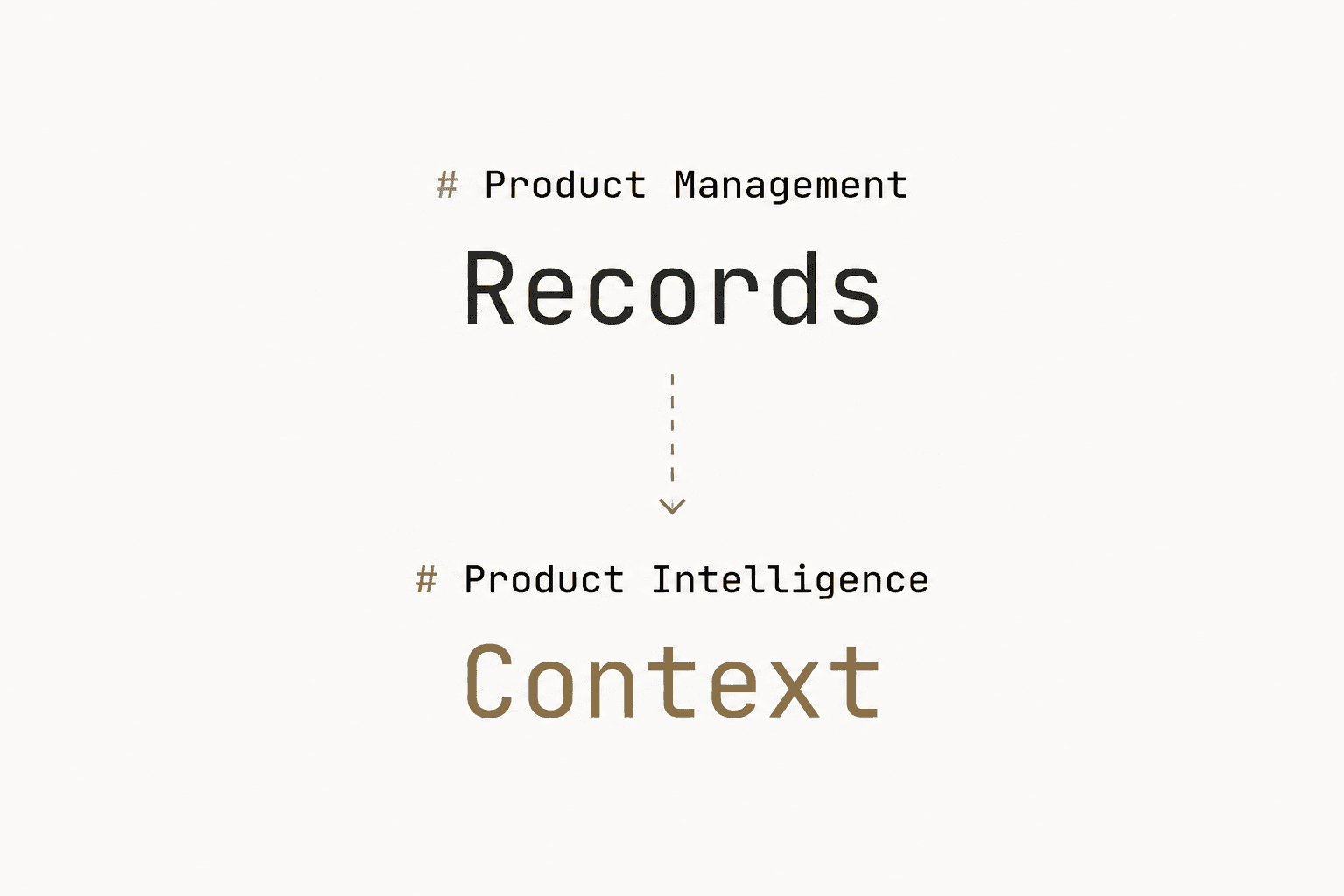
From Product Management to Product Intelligence
For years, product management software has focused on helping teams manage work.
The next generation will focus on helping teams understand reality.
That's a much bigger opportunity.
Because ultimately, product teams don't need another place to store information.
They need help answering three questions:
What is happening?
Why is it happening?
What should we do next?
The platforms that can answer those questions continuously, across customers, products, and business context, will define the future of product management.
Perhaps they won't even be called product management tools anymore.
Perhaps the category we're moving toward is product intelligence.
And the companies built for that future won't be the ones that simply added AI to existing workflows.
They'll be the ones that rebuilt the foundation around intelligence from the beginning.
A Personal Note
Of course, I could be completely wrong.
The future may look very different from what I imagine today.
But after spending years working with product teams, building products, talking to customers, and watching how AI is changing software, this is the direction I keep coming back to.
I don't believe the future of product management is another roadmap tool.
I don't believe it's another feedback repository.
And I don't believe adding AI features to existing workflows is enough.
I think we're moving toward a world where product systems continuously understand customer, product, and business context, and make that understanding available to both humans and agents.
A world where intelligence becomes the foundation, and interfaces become consumers of that intelligence.
That's the reason I'm building Lane.
Not as another product management tool, but as a product intelligence platform designed for the agentic era.
Whether this vision turns out to be right or wrong, it's a problem I find deeply interesting, and one worth dedicating years to exploring.
- Ishan
Over the last decade, product management software has largely remained the same.
We improved user interfaces.
We added integrations.
We created better roadmaps, better feedback systems, better documentation tools, and better analytics.
Yet the underlying architecture of product management hasn't fundamentally changed.
Most product teams still operate using a collection of systems designed around a simple assumption:
Humans are the primary consumers of information.
That assumption is starting to break.
Not because AI can summarize meeting notes or generate PRDs.
But because we are entering a world where software is no longer consumed exclusively through graphical interfaces.
For decades, software had two primary surfaces:
APIs for machines
GUIs for humans
Now there is a third.
Agents.
Whether it's ChatGPT, Claude, Cursor, internal company agents, or workflows that haven't been invented yet, products are increasingly being consumed, queried, and operated through AI systems.
This changes more than user experience.
It changes how product organizations need to think about information itself.
The Problem Isn't That Teams Lack Data
Modern product teams are drowning in information.
Customer feedback flows in from support tickets, sales calls, Slack conversations, CRM systems, surveys, communities, and interviews.
Product data comes from analytics platforms, feature usage, experiments, releases, and telemetry.
Business context lives inside revenue reports, company goals, strategic initiatives, and planning documents.
Most organizations don't have an information problem.
They have an understanding problem.
Every important product decision requires someone to manually connect dozens of signals scattered across multiple systems.
A product manager becomes the translation layer.
They spend their time gathering context, synthesizing information, identifying patterns, and helping the organization understand what matters.
The challenge is that the volume of information is growing faster than our ability to process it.
Adding more dashboards doesn't solve this.
Adding more records doesn't solve this.
Adding more tools doesn't solve this.
Traditional Product Management Software Was Built for a Different Era
Most product management platforms were designed during a time when execution was expensive and information was scarce.
Building software took months.
Research took weeks.
Documentation was written manually.
Engineering capacity was the primary constraint.
As a result, the industry developed processes optimized around coordination:
Backlogs
Sprint planning
Roadmaps
Feature prioritization frameworks
Requirements documents
Quarterly planning cycles
These systems made sense because the hardest part was organizing work.
Today, that assumption is changing.
AI is dramatically reducing the cost of execution.
Tasks that once required weeks of specification, design, implementation, and iteration can increasingly happen in days.
As execution accelerates, a new bottleneck emerges.
The bottleneck is no longer building.
The bottleneck is understanding.
Understanding customers.
Understanding opportunities.
Understanding business impact.
Understanding trade-offs.
Understanding what deserves attention next.
This is where many existing tools begin to show their age.
Adding AI to Existing Workflows Isn't Enough
Most software vendors are responding predictably.
They're adding AI features.
AI summaries.
AI search.
AI copilots.
AI-generated roadmaps.
AI-generated requirements.
These features are useful.
But they don't address the underlying issue.
They're improving workflows that were designed before AI existed.
The architecture remains unchanged.
Information is still fragmented.
Context is still scattered.
Humans are still responsible for connecting the dots.
The system still acts primarily as a repository.
It stores information.
It doesn't understand it.
The future requires something different.
Product Intelligence Is a Different Category
The next generation of product platforms won't be defined by better roadmaps or better feedback collection.
They'll be defined by their ability to continuously transform information into understanding.
Instead of acting as a system of record, the platform becomes a system of intelligence.
It continuously analyzes:
Customer feedback
Product usage
Strategic objectives
Revenue signals
Customer conversations
Research findings
Product decisions
Documentation
Its job is not simply to store data.
Its job is to create context.
To identify relationships.
To surface patterns.
To explain why something matters.
To continuously build an understanding of the business.
In this model, intelligence becomes the foundation.
Everything else becomes an interface on top.
The Most Important Consumer May Not Be the User Interface
This is where many people underestimate the shift.
Historically, software was designed around screens.
Dashboards.
Lists.
Forms.
Reports.
The interface was the product.
In an agent-native world, the interface becomes only one way to access intelligence.
The same understanding should be consumable through:
A web application
An API
An internal AI agent
ChatGPT
Claude
Cursor
Future AI systems
These systems don't need dashboards.
They need context.
They need structured understanding.
They need information that has already been analyzed, connected, and synthesized.
This changes how platforms should be designed from the ground up.
Knowledge Becomes the Product
Many organizations unknowingly possess extraordinary knowledge.
Years of customer conversations. Thousands of feedback items. Hundreds of product decisions. Countless strategic discussions.
The problem is that this knowledge exists in fragmented records.
The information exists.
The understanding does not.
The next generation of platforms will focus on continuously transforming raw information into living knowledge.
Not static documentation. Not manually maintained wikis. Not disconnected records.
But continuously updated representations of:
Customer needs
Product opportunities
Strategic priorities
Historical decisions
Business context
Knowledge that both humans and AI systems can understand.
Knowledge that compounds over time.
Knowledge that becomes more valuable with every interaction.
From Product Management to Product Intelligence
For years, product management software has focused on helping teams manage work.
The next generation will focus on helping teams understand reality.
That's a much bigger opportunity.
Because ultimately, product teams don't need another place to store information.
They need help answering three questions:
What is happening?
Why is it happening?
What should we do next?
The platforms that can answer those questions continuously, across customers, products, and business context, will define the future of product management.
Perhaps they won't even be called product management tools anymore.
Perhaps the category we're moving toward is product intelligence.
And the companies built for that future won't be the ones that simply added AI to existing workflows.
They'll be the ones that rebuilt the foundation around intelligence from the beginning.
A Personal Note
Of course, I could be completely wrong.
The future may look very different from what I imagine today.
But after spending years working with product teams, building products, talking to customers, and watching how AI is changing software, this is the direction I keep coming back to.
I don't believe the future of product management is another roadmap tool.
I don't believe it's another feedback repository.
And I don't believe adding AI features to existing workflows is enough.
I think we're moving toward a world where product systems continuously understand customer, product, and business context, and make that understanding available to both humans and agents.
A world where intelligence becomes the foundation, and interfaces become consumers of that intelligence.
That's the reason I'm building Lane.
Not as another product management tool, but as a product intelligence platform designed for the agentic era.
Whether this vision turns out to be right or wrong, it's a problem I find deeply interesting, and one worth dedicating years to exploring.
- Ishan
Expected a CTA? We're are working on it.
If you are still not convinced, give lane a try yourself.
Expected a CTA? We're are working on it.
If you are still not convinced, give lane a try yourself.