Oct 29, 2025
Articles
Modern Alternative to airfocus for Product Teams (2026)
Riley


airfocus is a popular choice for product teams looking to bring structure to prioritization and roadmapping. Its focus on scoring models, frameworks, and strategic planning makes it appealing, especially for teams that want more rigor than spreadsheets.
However, as many product teams grow, they begin to realize that prioritization alone isn’t the real bottleneck.
The harder problems usually come earlier:
Making sense of growing volumes of customer feedback
Identifying real opportunities (not just feature ideas)
Understanding customer and business impact together
Keeping discovery, prioritization, and planning connected
This is where teams start exploring free alternatives to airfocus — not just to save cost, but to find a workflow that better fits modern product discovery.
In this guide, we’ll look at what airfocus does well, where teams often feel friction, and how modern tools like Laneapproach product discovery and planning differently.
What airfocus Does Well
airfocus is designed around helping product teams bring structure to decision-making.
Teams commonly appreciate airfocus for:
Clear prioritization frameworks and scoring models
Strategic views that help align initiatives
Roadmapping and visualization capabilities
A structured, opinionated approach to planning
For teams that already have clean inputs — well-defined ideas, validated problems, and structured data — airfocus can be effective at helping choose what ranks higher.
Where airfocus Starts to Feel Limiting
As product teams mature, their needs evolve beyond scoring ideas.
Common challenges teams experience include:
1. Discovery Happens Outside the Tool
Most discovery inputs — customer feedback, sales insights, support tickets, and interviews — don’t naturally live in airfocus.
This means teams often:
Analyze feedback in other tools or spreadsheets
Manually summarize insights before bringing them into airfocus
Lose context between raw feedback and prioritized initiatives
Prioritization becomes disconnected from real customer signals.
2. Heavy Emphasis on Frameworks, Less on Insight Quality
Scoring frameworks are only as good as the data behind them.
When insights are:
Manually curated
Incomplete
Lacking trend or segment context
Prioritization scores can give a false sense of confidence.
Teams don’t just need a place to score ideas — they need help identifying which ideas deserve scoring in the first place.
3. Tooling Overhead for Smaller or Lean Teams
airfocus works well for teams that can invest time in setup and maintenance.
For lean teams, however:
Managing fields and frameworks can feel heavy
Updating data becomes manual work
Discovery feels slowed down rather than accelerated
This is often where teams begin looking for simpler, more connected alternatives.
What to Look for in a Modern airfocus Alternative
When evaluating a free or lightweight alternative to airfocus, modern product teams often prioritize:
Integrated discovery — feedback, insights, and opportunities in one place
Automatic insight analysis instead of manual summarization
Customer + business context baked into prioritization
Connected planning where roadmaps reflect real discovery signals
Low setup overhead with room to scale
The goal isn’t fewer features - it’s fewer disconnected steps.
Lane: A Free, Modern Alternative to airfocus
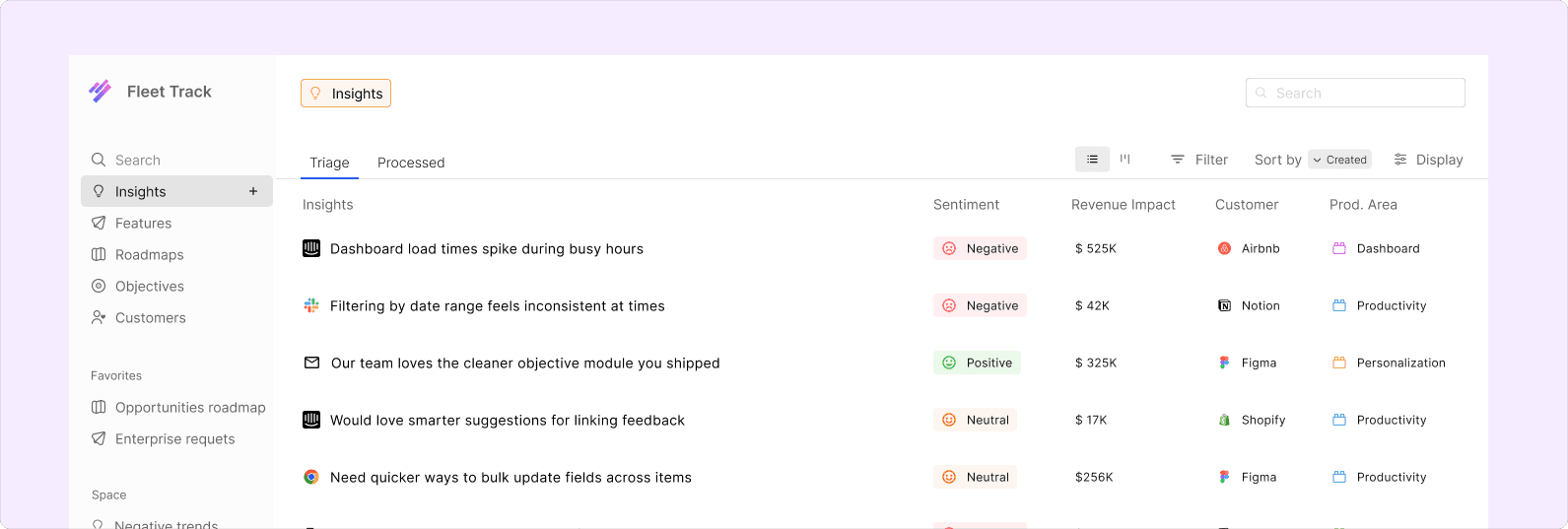
Lane approaches product management from the discovery side first — and that changes everything.
Instead of starting with frameworks, Lane starts with real customer signals.
With Lane, product teams can:
Collect feedback from Slack, Intercom, HubSpot, and other sources
Automatically analyze feedback to surface sentiment, insight type, and category
Identify opportunities based on customer impact and business relevance
Prioritize opportunities with full context, not just scores
Plan roadmaps that stay connected to discovery
This makes Lane especially useful for teams that want clarity before structure.
Because Lane focuses on connected discovery and planning, teams spend less time maintaining systems and more time making decisions.
You can get started with Lane for free and see how this workflow feels in practice.
airfocus vs Lane: How Teams Use Them Differently
A simple way to think about the difference:
airfocus helps answer: “Which initiatives should rank higher?”
Lane helps answer: “What opportunities exist, and which ones truly matter?”
Many teams that move to Lane aren’t replacing prioritization — they’re improving the inputs that prioritization depends on.
Lane becomes the place where:
Feedback is understood
Opportunities are formed
Context is preserved
And only validated, high-impact initiatives move forward into planning.
Who Should Consider Lane as an airfocus Alternative
Lane is a strong fit if your team:
Is managing feedback across multiple channels
Wants AI to reduce manual discovery work
Needs prioritization grounded in customer and business impact
Prefers lightweight, intuitive tools over heavy configuration
Is early-stage or scaling without dedicated ops resources
FAQ
Is Lane really a free alternative to airfocus?
Lane offers a free plan that supports core discovery and planning workflows, making it a viable alternative for teams evaluating airfocus.
Does Lane support prioritization frameworks?
Lane focuses on opportunity-level prioritization using real customer and business context rather than rigid scoring frameworks.
Can Lane replace airfocus completely?
For teams whose main challenge is discovery, insight analysis, and connected planning, Lane can replace the need for airfocus.
Is Lane suitable for small teams?
Yes. Lane is designed to be lightweight and intuitive, making it easy for lean teams to adopt without heavy setup.
Final Thoughts
airfocus is a solid tool for structured prioritization - but modern product teams face challenges that start much earlier than scoring ideas.
Discovery, insight quality, and context matter more than frameworks alone.
Tools like Lane reflect this shift. By connecting feedback, opportunities, prioritization, and planning in one place, Lane offers a modern, free alternative to airfocus — especially for teams that want clarity before complexity.
If you’re exploring better ways to handle discovery and planning, you can get started with Lane and see how a connected approach changes your workflow.
airfocus is a popular choice for product teams looking to bring structure to prioritization and roadmapping. Its focus on scoring models, frameworks, and strategic planning makes it appealing, especially for teams that want more rigor than spreadsheets.
However, as many product teams grow, they begin to realize that prioritization alone isn’t the real bottleneck.
The harder problems usually come earlier:
Making sense of growing volumes of customer feedback
Identifying real opportunities (not just feature ideas)
Understanding customer and business impact together
Keeping discovery, prioritization, and planning connected
This is where teams start exploring free alternatives to airfocus — not just to save cost, but to find a workflow that better fits modern product discovery.
In this guide, we’ll look at what airfocus does well, where teams often feel friction, and how modern tools like Laneapproach product discovery and planning differently.
What airfocus Does Well
airfocus is designed around helping product teams bring structure to decision-making.
Teams commonly appreciate airfocus for:
Clear prioritization frameworks and scoring models
Strategic views that help align initiatives
Roadmapping and visualization capabilities
A structured, opinionated approach to planning
For teams that already have clean inputs — well-defined ideas, validated problems, and structured data — airfocus can be effective at helping choose what ranks higher.
Where airfocus Starts to Feel Limiting
As product teams mature, their needs evolve beyond scoring ideas.
Common challenges teams experience include:
1. Discovery Happens Outside the Tool
Most discovery inputs — customer feedback, sales insights, support tickets, and interviews — don’t naturally live in airfocus.
This means teams often:
Analyze feedback in other tools or spreadsheets
Manually summarize insights before bringing them into airfocus
Lose context between raw feedback and prioritized initiatives
Prioritization becomes disconnected from real customer signals.
2. Heavy Emphasis on Frameworks, Less on Insight Quality
Scoring frameworks are only as good as the data behind them.
When insights are:
Manually curated
Incomplete
Lacking trend or segment context
Prioritization scores can give a false sense of confidence.
Teams don’t just need a place to score ideas — they need help identifying which ideas deserve scoring in the first place.
3. Tooling Overhead for Smaller or Lean Teams
airfocus works well for teams that can invest time in setup and maintenance.
For lean teams, however:
Managing fields and frameworks can feel heavy
Updating data becomes manual work
Discovery feels slowed down rather than accelerated
This is often where teams begin looking for simpler, more connected alternatives.
What to Look for in a Modern airfocus Alternative
When evaluating a free or lightweight alternative to airfocus, modern product teams often prioritize:
Integrated discovery — feedback, insights, and opportunities in one place
Automatic insight analysis instead of manual summarization
Customer + business context baked into prioritization
Connected planning where roadmaps reflect real discovery signals
Low setup overhead with room to scale
The goal isn’t fewer features - it’s fewer disconnected steps.
Lane: A Free, Modern Alternative to airfocus

Lane approaches product management from the discovery side first — and that changes everything.
Instead of starting with frameworks, Lane starts with real customer signals.
With Lane, product teams can:
Collect feedback from Slack, Intercom, HubSpot, and other sources
Automatically analyze feedback to surface sentiment, insight type, and category
Identify opportunities based on customer impact and business relevance
Prioritize opportunities with full context, not just scores
Plan roadmaps that stay connected to discovery
This makes Lane especially useful for teams that want clarity before structure.
Because Lane focuses on connected discovery and planning, teams spend less time maintaining systems and more time making decisions.
You can get started with Lane for free and see how this workflow feels in practice.
airfocus vs Lane: How Teams Use Them Differently
A simple way to think about the difference:
airfocus helps answer: “Which initiatives should rank higher?”
Lane helps answer: “What opportunities exist, and which ones truly matter?”
Many teams that move to Lane aren’t replacing prioritization — they’re improving the inputs that prioritization depends on.
Lane becomes the place where:
Feedback is understood
Opportunities are formed
Context is preserved
And only validated, high-impact initiatives move forward into planning.
Who Should Consider Lane as an airfocus Alternative
Lane is a strong fit if your team:
Is managing feedback across multiple channels
Wants AI to reduce manual discovery work
Needs prioritization grounded in customer and business impact
Prefers lightweight, intuitive tools over heavy configuration
Is early-stage or scaling without dedicated ops resources
FAQ
Is Lane really a free alternative to airfocus?
Lane offers a free plan that supports core discovery and planning workflows, making it a viable alternative for teams evaluating airfocus.
Does Lane support prioritization frameworks?
Lane focuses on opportunity-level prioritization using real customer and business context rather than rigid scoring frameworks.
Can Lane replace airfocus completely?
For teams whose main challenge is discovery, insight analysis, and connected planning, Lane can replace the need for airfocus.
Is Lane suitable for small teams?
Yes. Lane is designed to be lightweight and intuitive, making it easy for lean teams to adopt without heavy setup.
Final Thoughts
airfocus is a solid tool for structured prioritization - but modern product teams face challenges that start much earlier than scoring ideas.
Discovery, insight quality, and context matter more than frameworks alone.
Tools like Lane reflect this shift. By connecting feedback, opportunities, prioritization, and planning in one place, Lane offers a modern, free alternative to airfocus — especially for teams that want clarity before complexity.
If you’re exploring better ways to handle discovery and planning, you can get started with Lane and see how a connected approach changes your workflow.
Expected a CTA? We're are working on it.
If you are still not convinced, give lane a try yourself.
Expected a CTA? We're are working on it.
If you are still not convinced, give lane a try yourself.